
Why Blueprint Earth Clients Don't Need an Owner's Rep
Of the last 26 high-end residential projects tracked by Business of Home, 17 included an owner's representative.
Fifteen years ago, that number was 2 out of 22.
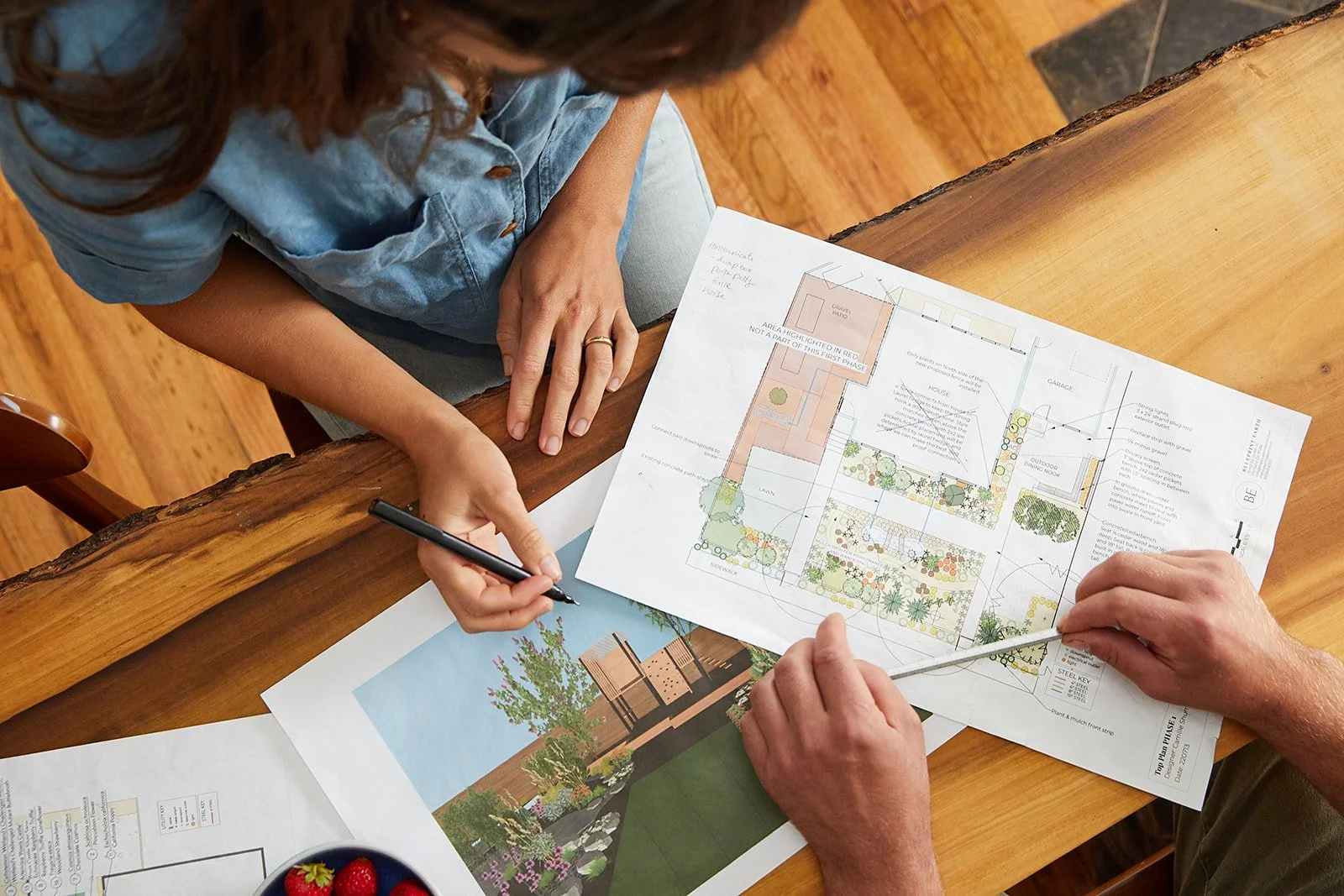
Reviewing plans for an upcoming design
That shift is worth paying attention to. Nt because owner's reps are a bad idea, but because of what their rise tells us about how the construction industry is working (and where it isn't).
An owner's rep is a hired advocate who sits between the client and the project team. They manage timelines, track budgets, coordinate between the designer and the contractor, and make sure nothing falls through the cracks. On complex residential builds, they can be genuinely valuable.
But here's what that trend is actually telling us: the fragmentation problem that makes owner's reps necessary doesn't exist in our model. At Blueprint Earth, we already are one.
Why Owner's Reps Exist at All
The traditional construction process separates design and build into distinct phases handled by distinct companies.
A designer creates the vision. A contractor bids on it. A project manager (sometimes the designer, sometimes a third party) tries to hold the whole thing together.
The client sits in the middle, passing notes between teams who barely talk to each other. That's where time leaks out. That's where money disappears. That's where the grade that won't drain gets built anyway because the contractor didn't understand the design intent and the designer wasn't on site to catch it.
Owner's reps exist to fill that gap. Their fees reflect the size of the problem: typically 1-5% of total construction costs, or $75-$250 per hour depending on scope. On $15M+ Miami builds, virtually every project now includes one.
This is a response to a broken system. It is not a feature of a good one.
The Research Case for Design-Build
Design-build isn't a niche delivery method. It now accounts for 47% of all U.S. construction spending and is on pace to reach 50% by 2028, according to a 2025 DBIA study.
The performance data is consistent:
36% faster construction and 102% faster overall delivery compared to design-bid-build (DBIA Data Sourcebook)
3.8% less cost growth across 212 projects studied (ASCE)
For residential landscape specifically, design-build typically costs 10-20% less than the separated approach for comparable scope (Classic Landscaping)
The reason is straightforward. As Custom Builder Online put it: "The most expensive thing in construction is miscommunication." Design-build eliminates the structural conditions that produce it.
When the team that designs a project also builds it, problems get caught in the drawing set, not in the field. Changes happen in pencil, not in change orders. The client gets one point of accountability instead of three companies pointing at each other.

What This Looks Like at Blueprint Earth
We produce full construction drawings, grading plans, and specifications that a contractor can actually build from. We hold the Regenerative Standard on every project: Water, Soil, Plants, Materials, Wildlife/Habitat, Process.
In practice, design-build means:
We catch problems in design, not the field. A grade that won't drain, a plant list that won't survive year three, a hardscape detail that creates a maintenance problem in year five. These are design decisions. We make them before a shovel goes in the ground, not after.
We over-communicate by design. The value isn't the project management spreadsheet. It's no surprises. Clients know what's coming before it happens, including the construction phase that looks worse before it looks better. We name that moment before it arrives. We prepare clients for the chaos. We slow down at the reveal so they can actually experience the transformation.
We're straight about money. One team, one scope. There's no designer to blame the contractor, no contractor to blame the designer. We stand behind the full project because we designed it and we built it.
We protect two clients: you, and the land. Blueprint Earth plants the water first before any other design decision. Before a single plant goes in the ground, we read the site: where water falls, where it pools, where it wants to go. We calculate infiltration rates based on actual soil composition. We select native plants for function first, appearance second. This is hydrology, soil science, and plant ecology applied with precision, not as philosophy.
What an Owner's Rep Can't Do
An owner's rep manages process. They are not a substitute for technical depth.
They can catch budget drift. They cannot catch a plant list that's wrong for the site's soil biology.
They can flag a schedule delay. They cannot tell you whether your drainage condition calls for a rain garden or a bioswale, or why that distinction matters for your property in year ten.
They can coordinate between your designer and your contractor. They cannot close the gap that exists when those are two separate companies with different incentives, different site knowledge, and different definitions of "done."
Technical depth is the product at Blueprint Earth. It is not an add-on. Our team is among BS and Masters in Landscape Architecture and is credentialed as a G3 Waterwise professionals, EPA WaterSense partners, and ISA Certified Arborists. Oregon LCB 9941. These aren't decorative credentials. They're the foundation of every site read, every plant selection, every grading decision we make.
Who This Is For
Not every client needs Blueprint Earth. But some clients are a very specific fit.
The clients who work best with us say things like:
"This is our forever home. We want to do it right."
"We have a drainage problem every winter and we're done patching it."
"Budget isn't the constraint. Doing it right is."
"We want one accountable team, not three companies who barely talk."
These are clients who are already thinking ecologically. They don't need convincing to invest in good work. They need confidence that the firm they hire has the technical depth to deliver on what they're promising, and the construction expertise to actually build it.
That's the gap we fill. Not with a third-party advocate sitting between the client and the project. With a single team that holds both sides of the work.
Design-Build Is the Accountability Structure
Owner's reps are a reasonable response to a fragmented industry. We understand why they exist. On a $15M build with five separate firms and a general contractor who's never met the interior designer, someone needs to hold the thread.
But for landscape clients investing in a forever home, a drainage solution, a regenerative property that improves over time, the answer isn't adding another layer of management to a broken process. The answer is a delivery model where the fragmentation doesn't exist in the first place.
Design-build isn't just a faster or cheaper way to build. It's the accountability structure. It's the reason our clients don't need someone to manage the gap between design and construction. There is no gap.
If you want the full methodology behind how we approach site assessment, water-led design, and the Regenerative Standard, it's in the newsletter. Sign up here
Ready to talk about your property?
Sources
Business of Home — The Rise of the Owner's Rep
https://businessofhome.com/articles/the-rise-of-the-owner-s-rep
Legal Clarity — Owner's Representative: Role, Scope, Fees
https://legalclarity.org/owners-representative-in-construction-role-scope-fees
Custom Builder Online / DBIA 2025 Study
https://www.custombuilderonline.com/custom-builder/business/leadership/article/55174066/mastering-the-art-of-communication
DBIA Data Sourcebook (delivery speed and cost growth data)
https://dbia.org/wp-content/uploads/2019/01/DBIA-Data-Sourcebook-1.pdf
ASCE Library — Cost growth study across 212 projects
https://ascelibrary.org/doi/10.1061/%28ASCE%29CO.1943-7862.0001896
Classic Landscaping — Design-build cost savings for residential landscape
https://classiclandscaping.com/blog/design-build-landscaping-process-seattle-saves-money
we plant the water first
|
we plant the water first |
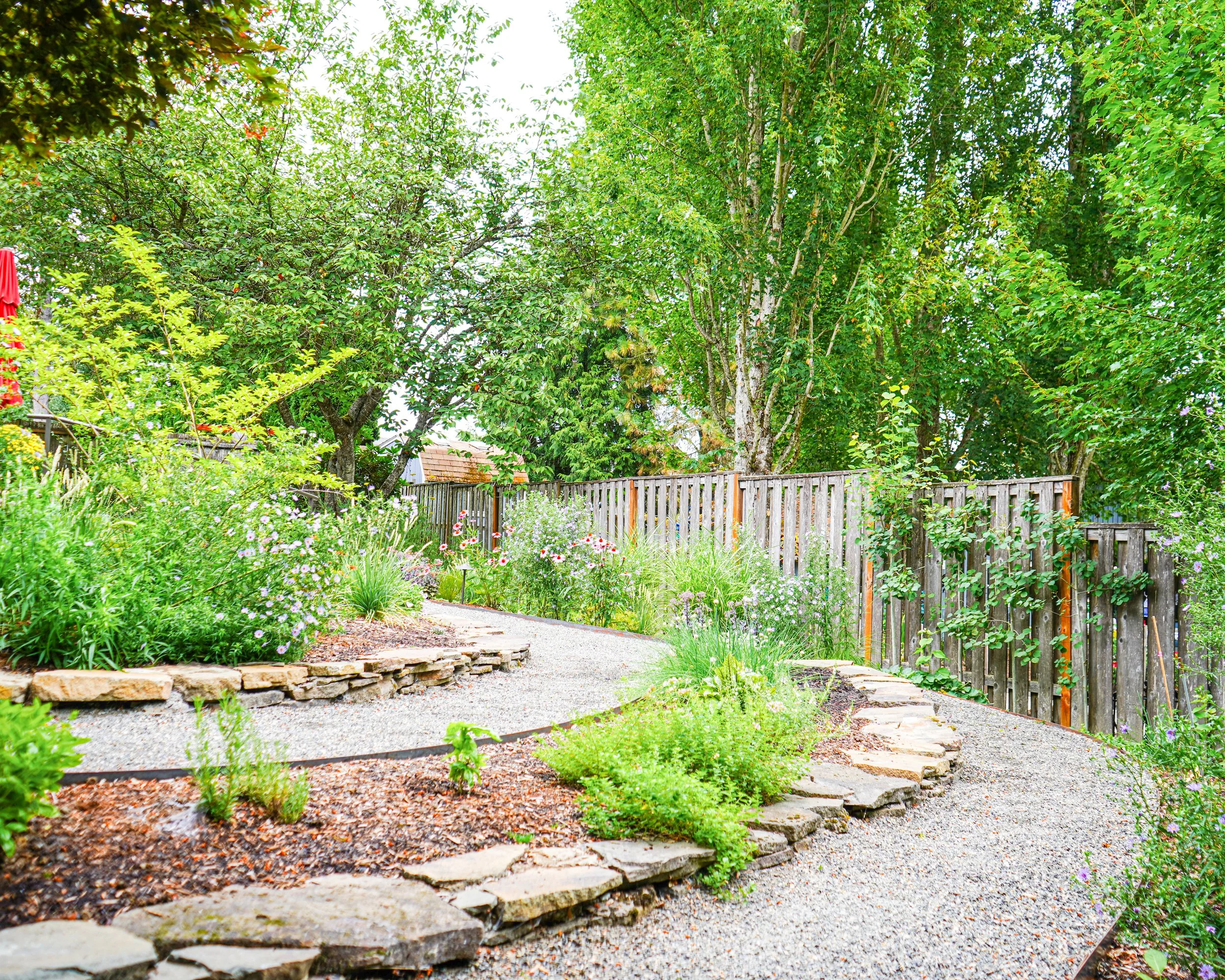
A sloped backyard lush with plants and meandering paths
FAQ
-
Blueprint Earth is a licensed design-build landscape firm in Portland, Oregon, founded by Brit Sastrawidjaya. The firm holds Oregon LCB 9941 and specializes in ecological, waterwise, and health-forward landscape design for Pacific Northwest homeowners.
-
An owner's rep is a hired advocate who sits between the client and the project team, managing timelines, tracking budgets, and coordinating between the designer and contractor. Fees typically run 1–5% of total construction costs, or $75–$250 per hour. They're common on complex builds where design and construction are handled by separate companies — but they manage process, not technical outcomes.
-
f your designer and contractor are separate companies, an owner's rep can help prevent things from falling through the cracks. If you hire a design-build firm, that coordination gap doesn't exist in the first place — the same team designs and builds the project, so there's no handoff to manage.
-
An owner's rep manages communication between separate design and construction companies. Design-build removes the need for that management by making one team responsible for both design and construction. One adds a layer to a fragmented process; the other eliminates the fragmentation.
-
Design-build firms catch problems in the drawing set instead of the field, because the people designing the project are the same people building it. Design-build now accounts for 47% of U.S. construction spending and is projected to reach 50% by 2028 (DBIA), with data showing 36% faster construction and 3.8% less cost growth compared to design-bid-build.
-
Design-build typically costs 10–20% less than the separated design-then-bid approach for comparable residential landscape scope, largely because miscommunication between separate design and construction teams is the most expensive failure point in a build. When one team holds both sides, changes happen on paper instead of as costly change orders in the field.
-
Not if your designer and contractor are the same firm. Management layers like owner's reps exist to bridge gaps between separate companies with different incentives. A design-build firm removes that gap by design — one team, one scope, one point of accountability.
-
A regenerative landscape firm designs and builds with long-term ecological function as the goal, not just appearance. Blueprint Earth applies this through the Regenerative Standard — Water, Soil, Plants, Materials, Wildlife/Habitat, and Process — starting by reading how water moves across a site before any other design decision is made.