
What Actually Protects a Home From Fire
It doesn't start with a wall of flame.
It starts with an ember. One ember, smaller than your thumbnail, carried on wind you didn't feel. It lands in the bark mulch against your foundation. The mulch is dry — it's August, it's Oregon, of course it's dry. The ember finds purchase. And then the house is on fire before the flame front ever reaches your street.
This is how most homes burn. Not consumed by the fire itself, but ignited by what the fire sends ahead of it. Embers travel up to a mile from the source. They land in gutters full of fir needles. They find the gap between your siding and your deck boards. They settle into the ornamental juniper you planted because it looked good against the fence.
Oregon just broke its wildfire record. People lost everything. And most of them had no idea their landscape was working against them.
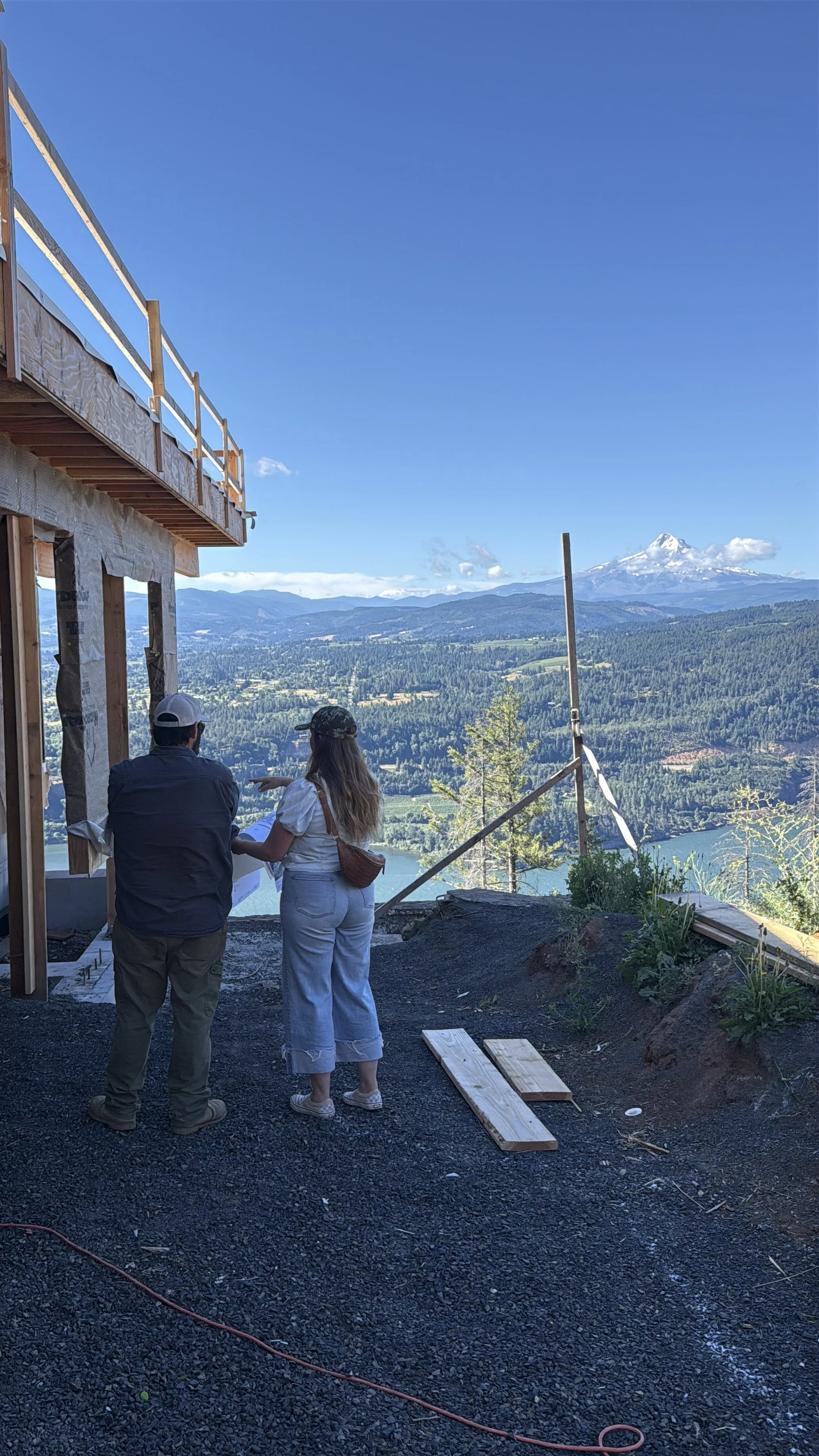
A home in Underwood, WA (across from Hood River, OR) under construction due to the Burdoin Wildfire in 2025
You Can't Stop a Wildfire. You Can Stop It From Taking Your Home.
This is not about fireproofing. There is no such thing.
What there is: fire-adapting. Removing the easy wins a fire would otherwise take. Changing the odds in the 100 feet around your house so that when embers arrive — and in Oregon, they will arrive — they don't find what they need to catch.
That 100-foot buffer has a name. Scientists call it the Home Ignition Zone. Retired U.S. Forest Service fire researcher Jack Cohen spent his career studying how homes actually ignite, and what he found changed everything: it's almost never the flame front that takes a house. It's the ember storm that precedes it. The flame front is dramatic. The embers are quiet, and they are everywhere.
Your landscape is either ready for them or it isn't.
The Three Zones.
Start Closest to the House. (Sources: OSU Extension, PNW 590; NFPA, "What Is the Wildfire Home Ignition Zone")
-
Nothing flammable against the house. Not bark mulch. Not juniper. Not the wood pile you've been meaning to move. Not the dry leaves that collected in the corner where the deck meets the siding.
Replace mulch with gravel, river rock, or pavers all the way to the foundation. Clean your gutters before fire season and again mid-season. Check the roof for debris after every windstorm.
This zone is where most home losses begin. Not at the property line. Not at the fence. Five feet from your front door.
(Source: Oregon State Fire Marshal, Defensible Space Program)
-
This is where people overcorrect. They strip everything out, end up with a gravel wasteland, and feel like they've done something. They haven't, really — and they've lost the living landscape that was doing other work for them.
You don't need to remove your plants. You need to space your groupings. OSU Extension is clear on this: the 10-foot rule applies to the gap between planting islands, not between individual plants. Dense, lush clusters of the right natives are fine. What you're breaking up is the continuous fuel path — the unbroken line of vegetation that lets fire run.
The plants that belong here are high-moisture, low-resin, and native to this region. Red-flowering currant. Vine maple. Woodland strawberry. Kinnikinnick. Oregon grape. These are not sacrificial plants. They're doing real ecological work while also being genuinely fire-resistant.
What doesn't belong here: juniper, arborvitae, ornamental grasses. All common. All combustible.
Source: OSU Extension, PNW 590)
-
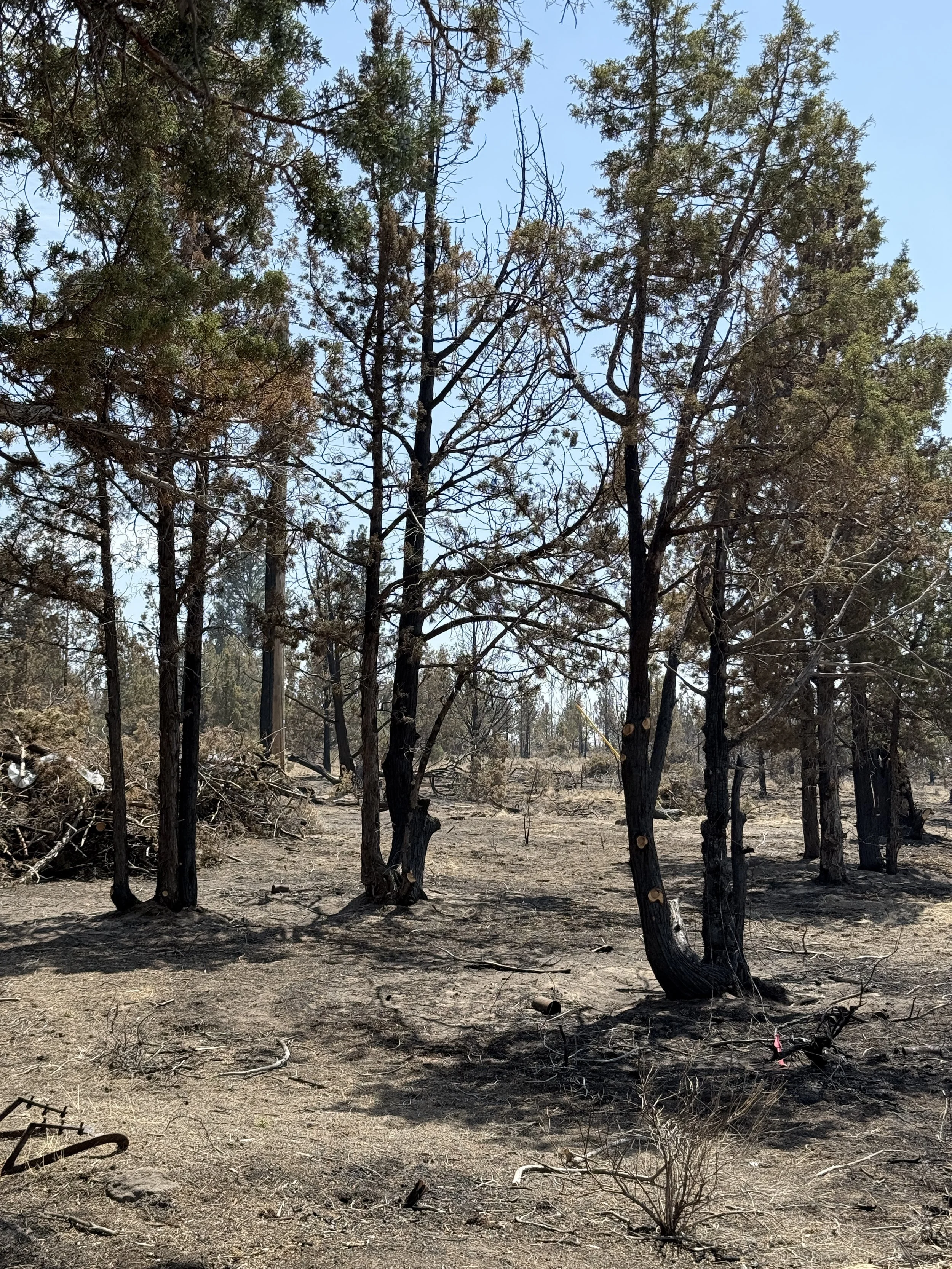
Thin trees so crowns don't touch. Remove dead wood. Keep grass mowed low through fire season. The goal is slowing fire's approach, not a moonscape.
The Ladder
This Is the One That Kills People.
Grass under shrubs under low branches under canopy.
That sequence is a ladder. A ground fire finds the grass, climbs to the shrubs, reaches the low branches, and suddenly you have a crown fire moving at a speed that no one can outrun and no firefighter can safely approach.
Removing ladder fuels is one of the highest-impact things you can do, and it costs almost nothing. Mow low. Prune branches within 10 feet of the ground. Keep shrubs from growing into tree crowns. OSU Extension recommends a minimum 15-foot gap between the lowest branches and the home itself.
Every rung you remove is a rung fire can't climb.
(Source: OSU Extension, PNW 590)
This Is Not a One-Time Project.
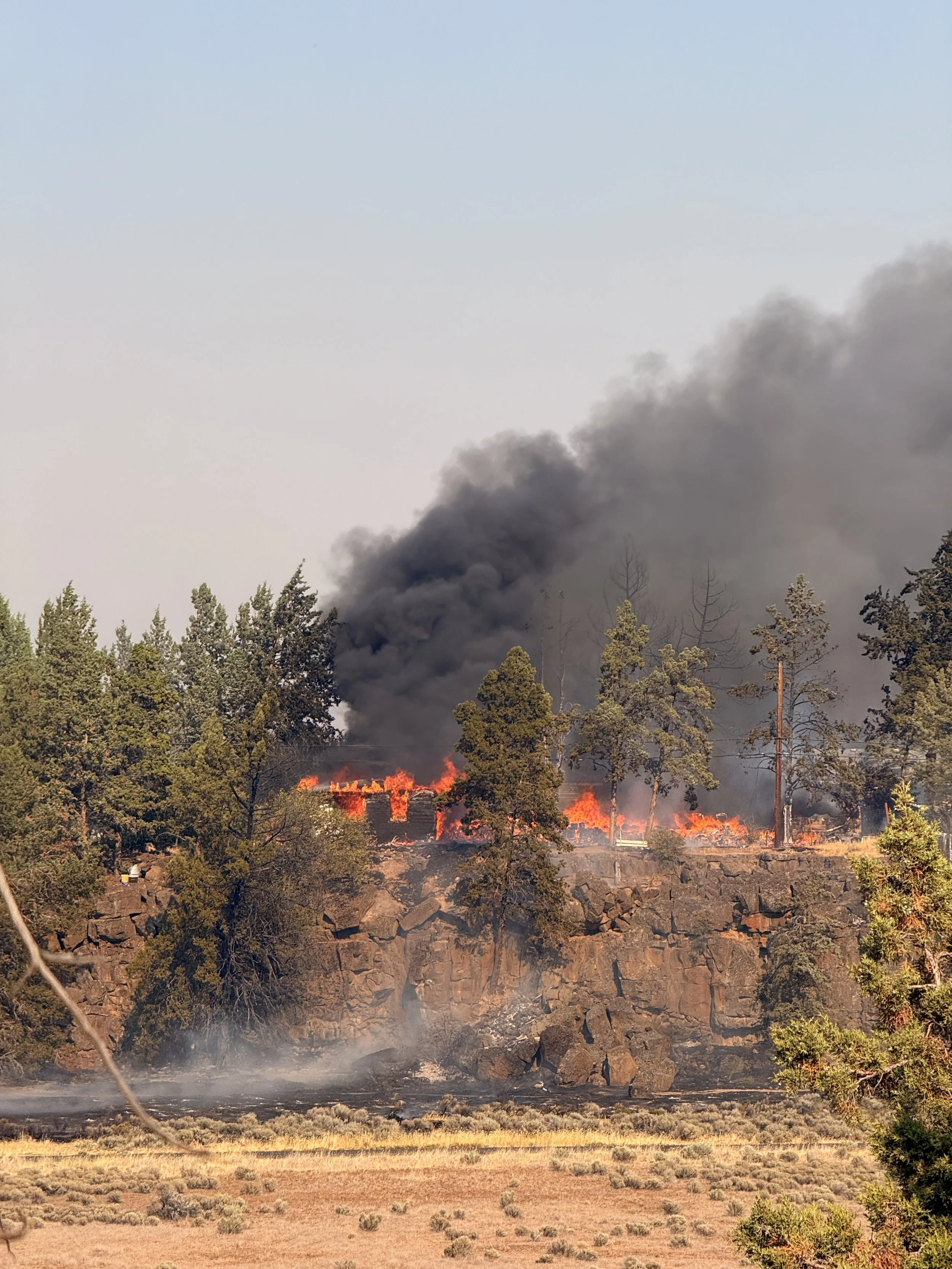
A fire a few miles from Redmond, OR, summer 2026
You don't have to do all of this at once. But you have to start.
Clear the immediate zone this weekend. It's five feet. It's an afternoon. Move the wood pile. Swap the bark mulch for gravel. Clean the gutters. That one zone, done right, changes your odds more than anything else on this list.
Then work outward. A little at a time. The landscape doesn't have to be perfect to be meaningfully safer.
If you want the full guide — the complete plant list, the zone-by-zone breakdown, the maintenance schedule, all of it formatted to print and keep — we made it free. Take it. Use it. Share it with your neighbors.
If you're not ready for a full design and want to go deeper on Firewise planting for your specific region, OSU Extension's fire-resistant plant resources are some of the best available anywhere. Start there: extension.oregonstate.edu.
If You're Able to Help
People across Oregon lost everything this season. Not because they didn't care. Because the fire moved faster than anyone expected, and the landscape around their homes gave it every advantage.
If you're in a position to give:
Red Cross Cascades Region — Shelter, meals, disaster relief. redcross.org/local/oregon
211info.org — Oregon's verified clearinghouse for donation and drop-off needs.
Oregon Volunteers in Disaster (ORVID) — The official channel to volunteer. Please don't self-deploy.
Protect your home. Help your neighbors.
The two things are not separate.
Stay safe out there.
Free Resource
Download the Blueprint Earth Firewise Planting Guide formatted to print, save, and work from.
SOURCES
OSU Extension — Fire-Resistant Plants for Home Landscapes (PNW 590)
OSU Extension — Keeping Your Home and Property Safe from Wildfire (EM 9184)
OSU Extension — Extending Your Protection: Wildfire Fuels Maintenance in Northwest Oregon
Ready.gov — Home Builder's Guide to Construction in Wildfire Zones: Defensible Space
FAQ
-
Defensible space is the buffer between a home and the surrounding wildland vegetation where flammable material has been reduced or modified. It slows the spread of wildfire toward a structure and gives firefighters room to safely defend it.
-
Guidance generally calls for defensible space out to 100 feet from a structure, and up to 200 feet on steep slopes, divided into three zones with different rules for each.
-
It refers to leaving at least 10 feet of low-fuel space between groups of plants in the 5–30 ft zone — not between every individual plant. The goal is to prevent a continuous path of fuel, not to eliminate planting.
-
Ladder fuels are the layered vegetation — tall grass, shrubs, low tree branches — that let a ground fire climb into a tree canopy. Removing them (mowing low, pruning branches within 10–15 feet of the ground) is one of the highest-impact defensible space actions.
-
At minimum, twice a year — once in winter and once in spring, ahead of fire season — since vegetation regrows and debris reaccumulates.
-
Yes. The Oregon State Fire Marshal offers free, advisory defensible space assessments to homeowners and renters through oregondefensiblespace.org.