
What we mean: We plant the water first

Before any plant goes in the ground, before we choose a stone or a shrub, we read the site hydrology, where water falls, where it pools, where it wants to go.
Most landscape problems are water problems.
The pooling in the corner of the yard after a storm. The soggy strip where nothing will grow. The plant that should be thriving but keeps dying back. The runoff that carries your soil, and everything on it, straight to the storm drain. In fifteen years of designing and building regenerative landscapes, I've learned that the ground beneath your landscape is either building toward something or degrading. There's no neutral.
We plant the water first. That phrase is ours, and it's not metaphorical. Before any plant goes in the ground, before we choose a stone or a shrub, we read the site hydrology, where water falls, where it pools, where it wants to go. That intelligence shapes everything that follows.
What Conventional Landscaping Does Underground

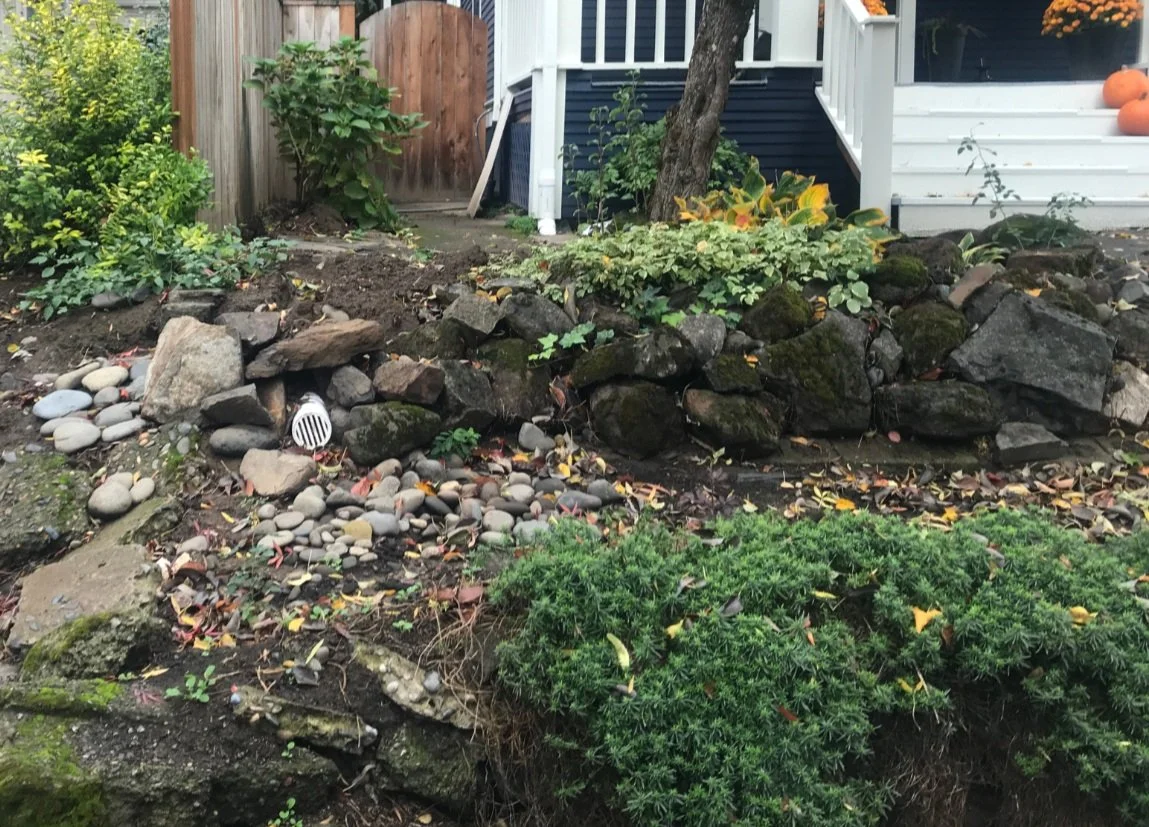
Before: a Portland, OR driveway with water funneled from the gutters onto the street. Rerouting the water to be your neighbor’s problem is not the solution. See this project breakdown
A typical residential property sends 30,000 to 50,000+ gallons of polluted runoff to storm drains every year, untreated, straight to the river. That water picks up everything it touches on the way: fertilizer, oil, pet waste, pesticide residue. The storm drain is not a filter.
Most landscaping makes this worse. Impermeable hardscapes increase runoff velocity. Poor grading pushes water toward structures instead of away from them. Compacted soils, the result of heavy equipment and synthetic inputs, can no longer absorb anything. The rain hits and runs.
Then there's the soil itself. Healthy soil is a living system: billions of microorganisms, fungal networks, earthworm activity, organic matter that holds water and feeds plant roots. Most construction destroys it. Equipment compaction alone can collapse soil structure 12 to 18 inches deep. After that, you're growing plants in something that functions more like subsoil than topsoil. The maintenance treadmill, fertilize, aerate, water, repeat, is what it looks like when soil biology is gone.
The Water Standard: What We Do
Every project begins with a site-specific stormwater assessment. That means grading analysis before design, not assumed from a visual walk-through. We look at where water enters the site, where it moves, where it exits, and what it picks up along the way.
From there: stormwater retained or infiltrated on-site where possible. Bioretention zones designed where appropriate. Bioswales that infiltrate 30 to 70% more stormwater than conventional drainage. No net increase in impervious surface without a mitigation plan that meets or exceeds Oregon standards.
Photo shows a before Portland property with improper drainage “solutions” that will not stand the test of time.
Irrigation designed for efficiency, not default coverage. Overwatering is one of the most common causes of plant failure and soil compaction. Native plants use 80% less water than turf once established. The irrigation system should reflect that.
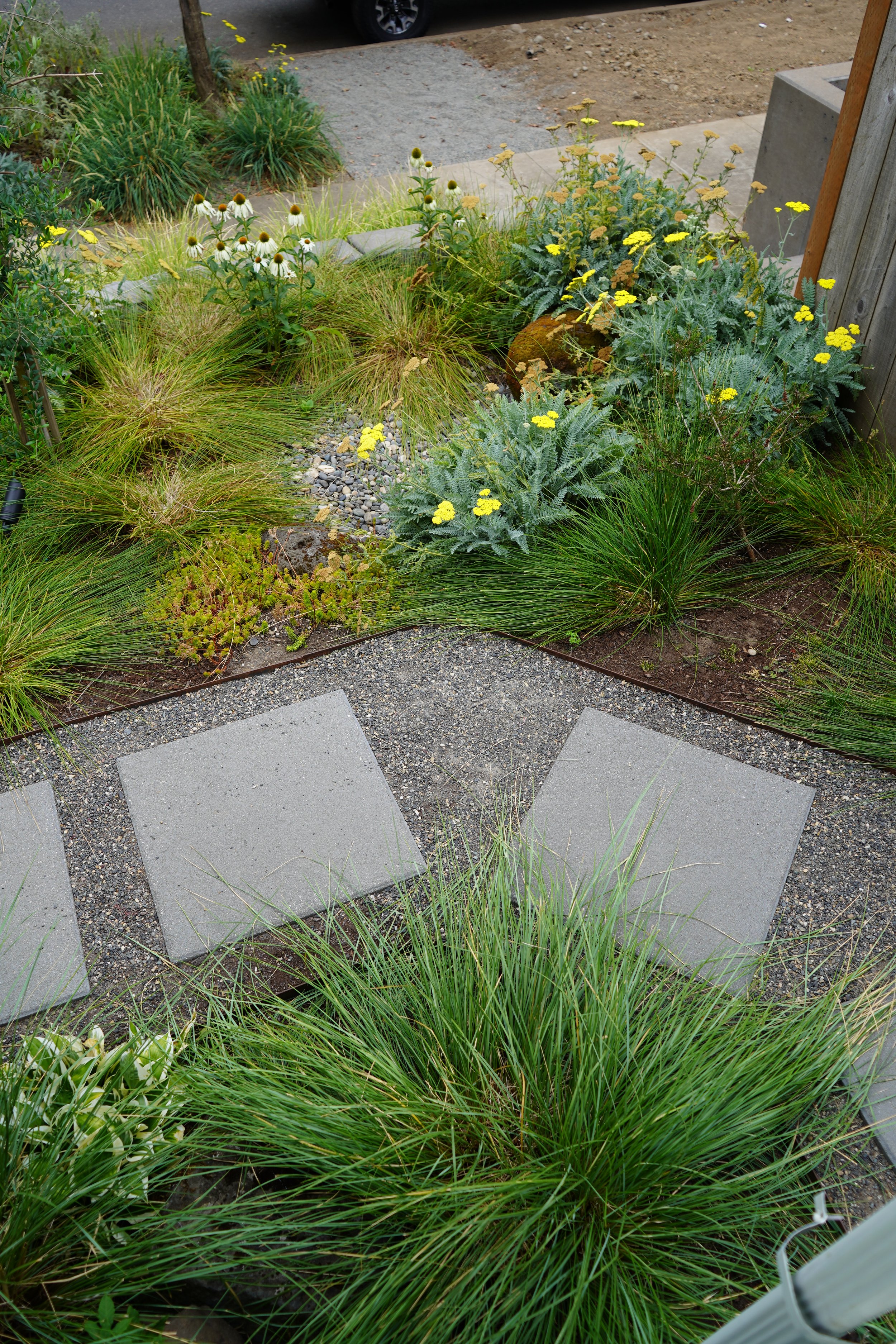
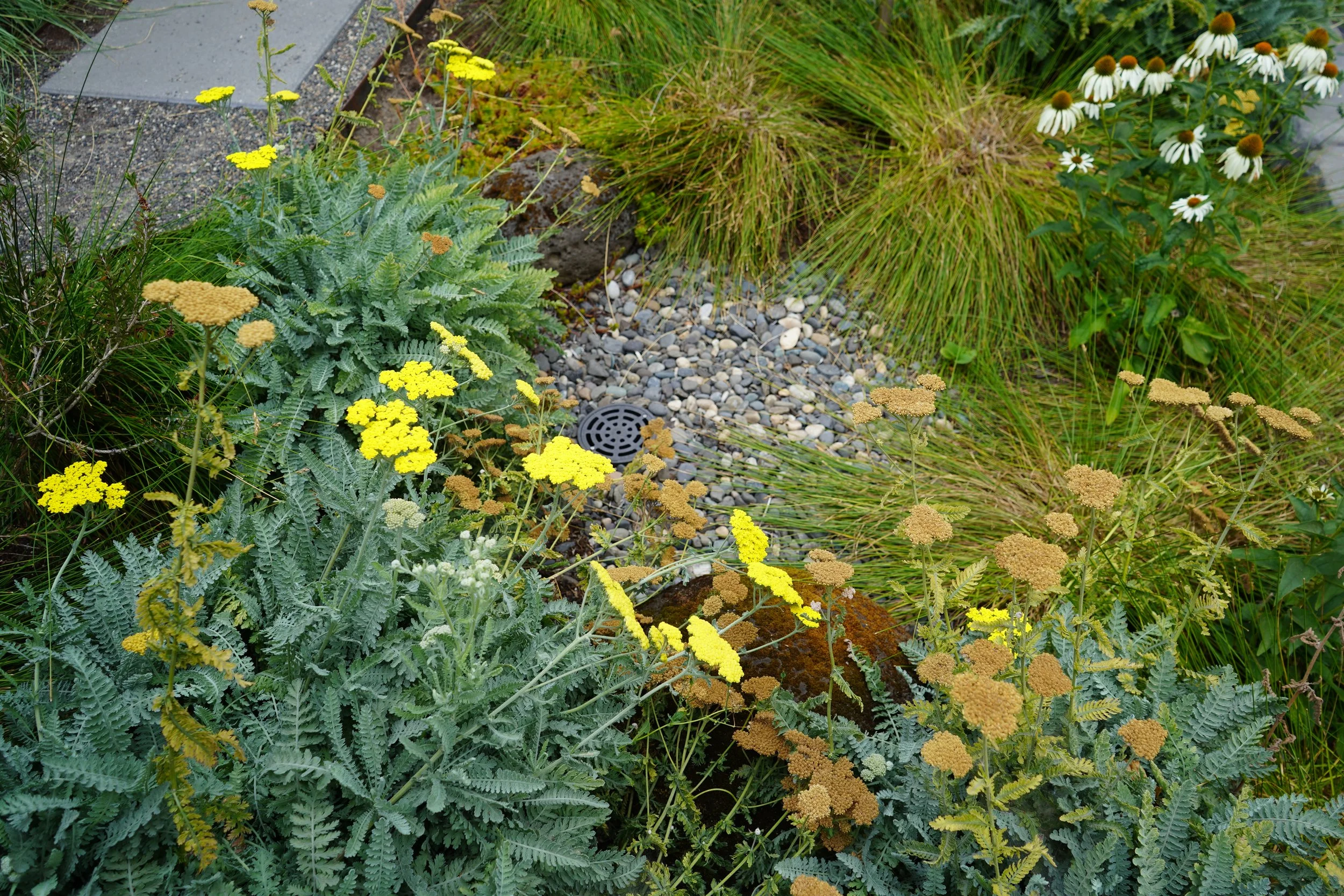
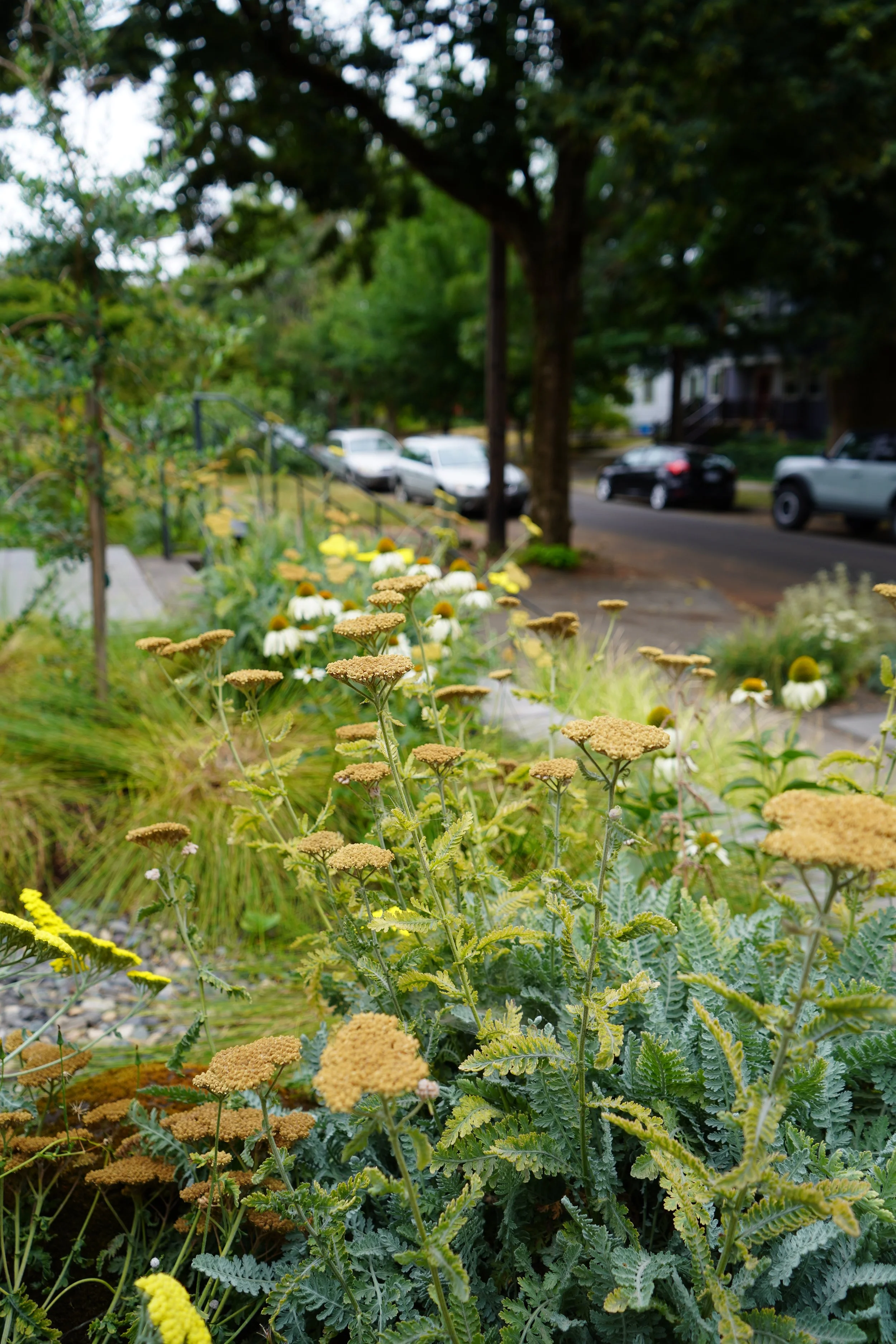
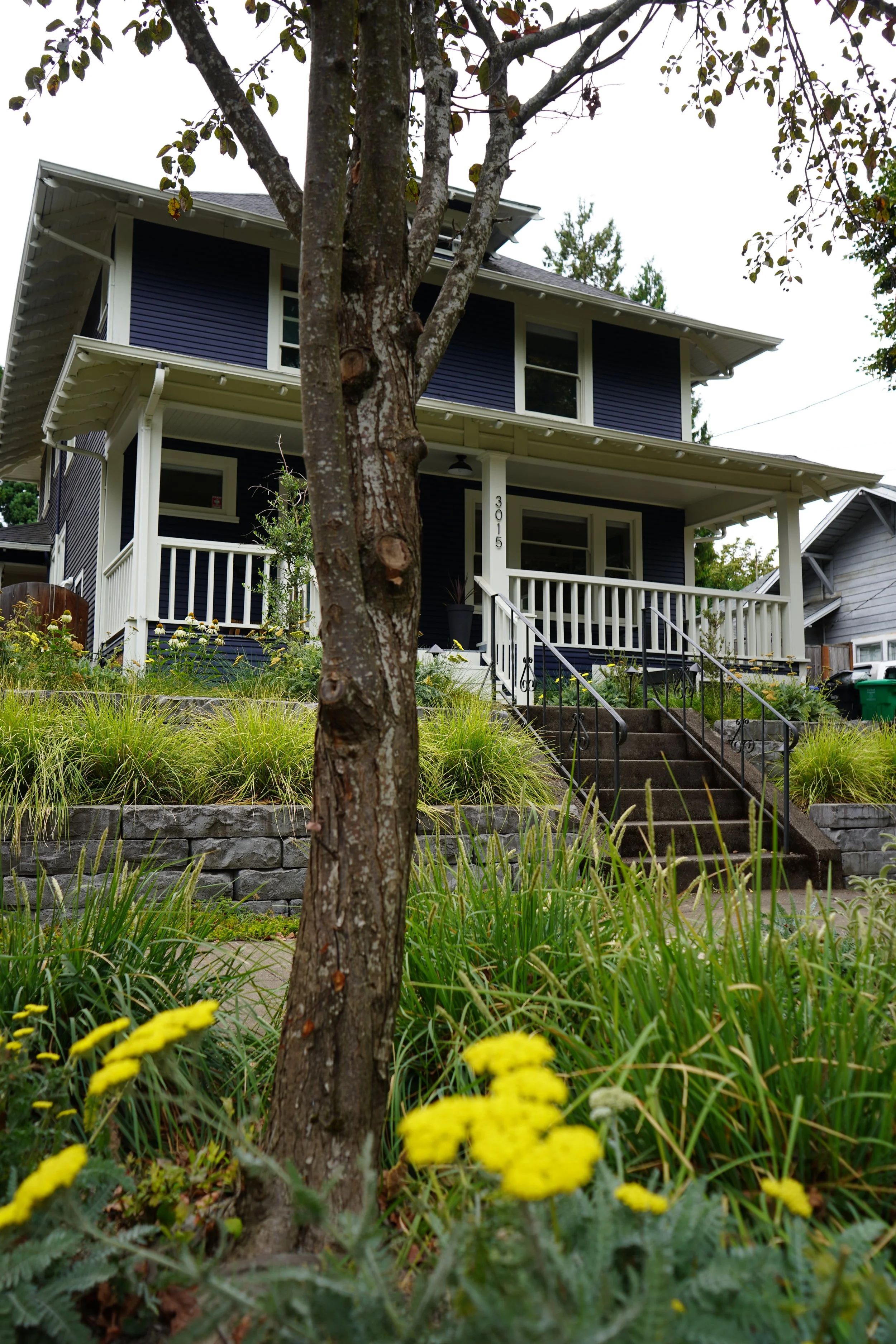
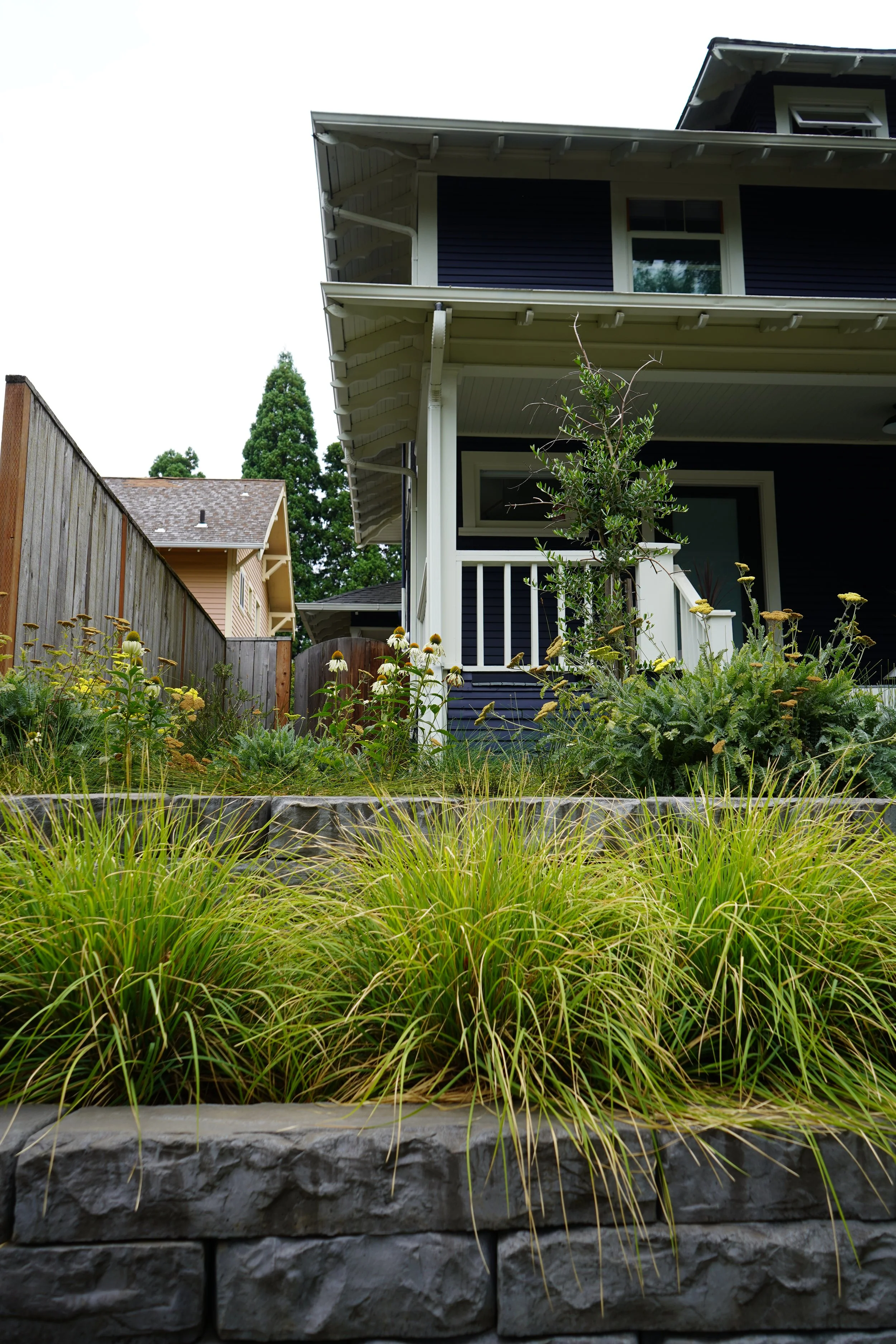
After: Rain gardens and bioswales capture the stormwater and filter it back into the soil. Precious resources rerouted back into your pocketbook.
The Soil Standard: What We Actually Do
Soil assessment happens before we disturb the site. Know what you're working with before you work it. Equipment and staging zones are planned to minimize compaction, protecting soil structure beyond the build footprint, not just within it.
After construction: organic matter reintegrated. No synthetic pre-emergent herbicides applied to soil. Compost-based amendments instead of synthetic fertilizer, feeding the soil food web, not just the plants. The goal is to restore microbial communities and water retention, which compounds over time.
Native roots reach 10 feet deep instead of the 4 to 6 inches under turf. Those deep roots build stable soil carbon that stays put, hold structure during heavy rain, and support plant communities that don't need chemical inputs to survive. The soil beneath a well-built regenerative landscape looks fundamentally different after three years than it did on installation day.
The Ground Beneath Your Landscape
Most landscape projects are designed for what they look like when they're completed. The soil and water story plays out over years, mostly invisibly, until something goes wrong.
A drainage remediation in Portland typically runs $8,000 to $25,000 or more per cycle. Regrading. Drains added after the fact. Replanting failed areas. A regenerative design starts with the grading analysis before the first plant goes in, and solves it once. The upfront work pays for itself.
Your property is either building biological capital underground or depleting it. There's no standing still.
Ready to talk about your site? Schedule a Garden Chat
Checkout the Land Language Podcast to learn from those changing the industry. Listen here
Join us for our upcoming speaking engagements Here
Reference Links
-
Gregory et al. (2006) — "Effect of Urban Soil Compaction on Infiltration Rate" (351 citations, open access)
Key data: Construction compaction reduced infiltration rates 70–99%. Non-compacted forest soils: 377–652 mm/hr. Compacted soils: as low as 8 mm/hr — effectively behaving like impervious surfaces.
scispace.com/papers/effect-of-urban-soil-compaction-on-infiltration-rate-3wnbcc92wsIowa Stormwater Research (2024) — "Decompaction and Organic Amendments Provide Short-Term Improvements in Soil Health"
Key data: Mechanical decompaction increased infiltration rate by over 2,000% and time-to-runoff by 463% vs. control.
iowastormwater.org/wp-content/uploads/IA-SQR-Research-2024.full_-1.pdfMDOT SHA — "The Effectiveness of Soil Decompaction for Stormwater Management"
Key data: Decompaction to 20+ inches + 2–3" compost restores infiltration to near-uncompacted levels. Runoff reductions of 0.8–1.5 inches for clay loam, silty clay, and similar soil textures.
rosap.ntl.bts.gov/view/dot/60230/dot_60230_DS1.pdfGalli et al. (2021) — "Evaluating the Infiltration Capacity of Degraded vs. Rehabilitated Urban Greenspaces" (Milan case study)
Key data: Peak infiltration capacity reached ~5 years post-rehabilitation. Without maintenance, capacity declines rapidly after 9–12 years.
air.unimi.it/handle/2434/843976
-
PubMed (2024) — "Compost Incorporation and Wildflowers for Stormwater Infiltration"
Key data: 30% compost reduced bulk density 19–24%, increased infiltration 2–3x vs. no-compost. 95–100% vegetation cover by month 13–24.
pubmed.ncbi.nlm.nih.gov/39222586/PubMed (2013) — "Remediation to Improve Infiltration into Compact Soils"
Key data: Compost addition increased Ksat 2.7–5.7x vs. control. Tilling alone showed little improvement (0.5–2.3x). Compost outperformed mechanical decompaction alone.
pubmed.ncbi.nlm.nih.gov/23353881/ScienceDirect (2016) — "Restoring Hydrologic Function in Urban Landscapes with Suburban Subsoiling"
Key data: Deep ripping + compost amendment produced highest infiltration rates, densest turf cover, highest soil organic matter, and lowest bulk density vs. standard grading.
sciencedirect.com/article/pii/S0022169416307041ScienceDirect (2014) — "Influence of Urban Land Development and Subsequent Soil Rehabilitation on Soil Aggregates, Carbon, and Hydraulic Conductivity"
Key data: Organic amendments improve water holding capacity, infiltration, and carbon storage. Urban tree canopy reduces peak discharge and increases soil permeability via root channels.
sciencedirect.com/article/pii/S0048969714009723
-
MDPI Water (2024) — "Catchment-Scale Hydrologic Effectiveness of Residential Rain Gardens: Columbia, MD"
Key data: 100% RG implementation reduced peak flows 14.3% and runoff volumes 11.4% across 223 storm events. Greater relative benefit for smaller storms.
mdpi.com/2073-4441/16/9/1304Frontiers in Environmental Science (2026) — "Hydrological Performance of a Raingarden in Edinburgh, Scotland"
Key data: Raingarden retained 100% of observed runoff. Summer infiltration 2.5x higher than winter. All ponding events de-watered within 48 hours.
frontiersin.org/articles/10.3389/fenvs.2026.1703556/fullUSGS Scientific Investigations Report (2022) — "Stormwater Reduction and Water Budget for a Rain Garden on Sandy Soil, Gary, Indiana"
Key data: Combined post-construction stormwater reduction of 80.3%. Rain garden removed 21–24% of precipitation annually. Evapotranspiration removed 29–47%.
pubs.usgs.gov/sir/2022/5101/sir20225101.pdfScienceDirect (2013) — "Field Evaluation of a Biphasic Rain Garden for Stormwater Flow Management and Pollutant Removal"
Key data: Removed ~91% nitrate, ~99% phosphate, ~90% atrazine, ~99% glyphosate, ~90% 2,4-D under high-load conditions. Reduced peak flow and runoff volume across 0.3–180mm rainfall events.
sciencedirect.com/article/pii/S0925857413000207MDPI Water (2025) — "Effectiveness of Water-Sensitive Urban Design Techniques at Residential Scale"
Key data: Rain gardens alone reduced peak flow exceedance 32–70%. Combined tank + rain garden + infiltration trench reduced mean annual runoff up to 90% under future conditions.
mdpi.com/2073-4441/17/6/899
-
ScienceDirect (2021) — "Next Generation Swale Design for Stormwater Runoff Treatment" (Review)
Key data: Swales reduce peak runoff rates 4–87% and runoff volumes 15–82% depending on soil, vegetation, and design. Performance highly variable — site-specific soil and infiltration data matter.
sciencedirect.com/article/pii/S0301479720316819MDPI Water (2024) — "Spatial and Temporal Variability in Bioswale Infiltration Rate: Riga, Latvia"
Key data: Infiltration rates varied 0.1–7.7 m/day across similar-design bioswales. Rates dropped 40–46% after saturation. Highlights why site-specific infiltration testing is non-negotiable.
mdpi.com/2073-4441/16/16/2219
-
Portland Bureau of Environmental Services — Residential Rain Gardens Guide
Portland-specific design requirements: size to 10% of drainage area, drain within 48 hours, use Portland Plant List natives. Infiltration test required before construction.
portland.gov/ppd/infrastructure/managing-rain-your-property/rain-gardensOregon State University Extension — "Home Rain Gardens Treat Stormwater and Reduce Flooding"
Oregon rainfall distributions (Type IA, I, II) and their design implications. References The Oregon Rain Garden Guide with plant lists for sunny/shady sites and three moisture zones.
extension.oregonstate.edu/news/home-rain-gardens-treat-stormwater-reduce-floodingOregon State University Extension — Stormwater Solutions for Green Infrastructure
Infiltration testing guidance for Oregon soils. Native plants framed as essential to healthy watersheds — "they support the insects, that feed the birds, that spread the seeds, that grow the forests, that manage stormwater."
extension.oregonstate.edu/stormwater-green-infrastructureOregon State University Extension — Rain Gardens: Low-Impact Development Fact Sheet (EM 9207)
Oregon-specific: Type IA storms (western Oregon) require 30-hour drain time. Type I/II require 72 hours. Design storm sizing per local jurisdiction.
extension.oregonstate.edu/sites/extd8/files/documents/em9207.pdfWashington State Department of Ecology — Rain Garden Handbook for Western Washington (2013)
Regional design, installation, and maintenance guide. WSU Extension authored. Covers soil mix, plant selection, and sizing for PNW climate conditions.
apps.ecology.wa.gov/publications/documents/1310027.pdfASCE (2012) — "Flow Control and Water Quality Treatment Performance of a Residential LID Pilot Project in Western Washington"
Meadow on the Hylebos project: bioretention swales, permeable concrete, compost-amended soils, and surface flow dispersion evaluated using Western Washington Hydrology Model.
ascelibrary.org/doi/10.1061/41099(367)113
FAQ- We Plant the Water First
-
Hydrology-first landscape design means reading a site's water behavior before making any design decisions. At Blueprint Earth, that means analyzing where water falls, where it pools, where it moves, and where it exits the site before a single plant is selected or a stone is placed.
Most landscape firms start with aesthetics and work backward to drainage. We start with the water and let that intelligence shape everything that follows: grading, plant selection, hardscape placement, irrigation design. The result is a landscape that works with the site's natural hydrology rather than fighting it.
This is what we mean when we say we plant the water first. It's not a philosophy. It's a sequence.
-
Because most landscape failures are water failures. The plant that keeps dying back, the soggy strip where nothing will grow, the drainage problem that shows up every winter — these are almost always symptoms of a hydrology problem that was never addressed at the design stage.
When water is designed first, plants go into conditions they can actually thrive in. Irrigation is sized for what the site and plant palette actually need, not default coverage. Grading directs water away from structures and toward infiltration zones. The result is a landscape that establishes faster, requires less intervention, and gets better over time rather than degrading.
Designing plants before water is designing for the day of completion. Designing water first is designing for year 3, year 10, and year 30.
-
Infiltration rate is the speed at which water moves through soil, typically measured in inches per hour. It determines how much stormwater a site can absorb and where bioretention features like rain gardens and bioswales should be sized and located.
At Blueprint Earth, we assess infiltration based on actual soil composition, not assumptions from a visual walk-through. Soil texture, compaction depth, organic matter content, and existing drainage patterns all factor in. A sandy loam infiltrates at a very different rate than a compacted clay subsoil, and designing as if they're the same produces systems that fail.
For complex sites or projects with significant impervious surface, we work with grading analysis and site-specific stormwater assessments to ensure bioretention zones are sized to handle the actual load. Oregon has specific standards for stormwater management, and our designs meet or exceed them.
-
Both are bioretention features designed to capture and infiltrate stormwater, but they function differently and serve different site conditions.
A rain garden is a planted depression that collects runoff from a defined area (typically a roof, driveway, or lawn) and allows it to infiltrate slowly into the soil. It's a contained feature, usually sized to handle a specific drainage area, and planted with species that tolerate both wet and dry conditions.
A bioswale is a linear channel designed to slow, filter, and infiltrate stormwater as it moves across a site. Where a rain garden captures and holds, a bioswale conveys and treats. Bioswales are particularly effective along driveways, property edges, and anywhere water needs to travel before it can infiltrate.
Both can infiltrate 30 to 70% more stormwater than conventional drainage when properly designed. The right choice depends on site topography, drainage area, and how water moves across the property.
-
Compacted soil loses its ability to absorb water. When soil structure collapses, the pore spaces that allow water to move through are eliminated. Rain hits the surface and runs instead of infiltrating.
Heavy equipment during construction is one of the most common causes. Equipment compaction can collapse soil structure 12 to 18 inches deep. After that, you're not working with topsoil anymore. You're working with something that functions more like subsoil, and no amount of surface planting fixes that without addressing the underlying structure.
At Blueprint Earth, equipment and staging zones are planned before construction begins to minimize compaction beyond the build footprint. After construction, we reintegrate organic matter and use compost-based amendments to restore microbial communities and water retention. Healthy soil biology is what makes infiltration possible over the long term.
-
Regenerative landscape design is an approach that improves a site's ecological function over time rather than simply maintaining it. The goal is a landscape that builds soil health, manages stormwater on-site, supports real habitat, and reduces or eliminates the need for chemical inputs as it establishes.
The distinction from conventional landscaping is directional. Conventional landscapes often degrade over time: soil compacts, inputs increase, maintenance costs rise. A well-built regenerative landscape moves in the opposite direction. Soil biology improves. Native plant communities establish and self-support. Stormwater infiltrates rather than running off. The landscape becomes more functional, not less, as it matures.
At Blueprint Earth, regenerative design is not a marketing term. It's a set of specific practices applied to every project: water-led design, soil assessment before disturbance, native plant selection for function, organic soil amendments, and construction methods that protect what's already working underground.
-
Most drainage problems are design problems. Water is pooling, running toward a foundation, or saturating a planting area because the grading, soil, or hardscape configuration is directing it there.
The right solution starts with a grading analysis before any remediation work begins. That means understanding where water enters the site, how it moves, and where it exits. From there, the design can address the actual cause: regrading to redirect flow, adding bioretention features to capture and infiltrate, replacing impermeable hardscape with permeable alternatives, or restoring soil structure so the ground can absorb what it's receiving.
A drainage remediation in Portland typically runs $8,000 to $25,000 or more per cycle when it's addressed after the fact. Regrading, drains added retroactively, replanting failed areas. A regenerative design solves it once at the design stage. The upfront grading analysis pays for itself.
-
The Blueprint Earth Regenerative Standard is the framework we apply to every project. It covers six pillars: Water, Soil, Plants, Materials, Wildlife and Habitat, and Process.
Water: Every project begins with a site-specific stormwater assessment. Stormwater is retained or infiltrated on-site where possible. No net increase in impervious surface without a mitigation plan that meets or exceeds Oregon standards.
Soil: Soil is assessed before the site is disturbed. Equipment zones are planned to minimize compaction. After construction, organic matter is reintegrated and compost-based amendments restore the soil food web.
Plants: Native plants are selected for function first, appearance second. Right plant, right place, based on actual site conditions: hydrology, soil type, sun exposure, and intended use.
Materials: Permeable hardscape where appropriate. Local sourcing prioritized. No pressure-treated lumber in soil contact zones. No landscape fabric.
Wildlife and Habitat: Pollinator corridors, canopy layering, and bird habitat are considered in planting design, not added as afterthoughts.
Process: How we build is part of the product. Construction methods must honor design intent. That's why we're design-build. When design and construction are in conversation on every project, the standard holds.
-
Native plants are adapted to the Pacific Northwest's rainfall patterns, which means they're built for the wet-dry cycle that defines our climate. Their root systems are the key.
Native plants develop deep root systems, often reaching 10 feet or more, compared to the 4 to 6 inches typical of turf. Those deep roots create channels in the soil that allow water to infiltrate rather than run off. They also build stable soil carbon, hold soil structure during heavy rain events, and support the microbial communities that keep soil porous over time.
Once established, native plants use approximately 80% less water than turf. That means irrigation systems can be sized for actual need rather than default coverage, which reduces both water use and the overwatering that contributes to soil compaction and plant failure.
The stormwater benefit compounds. As native plant communities establish and root systems deepen, infiltration capacity increases. The landscape gets better at managing water over time, not worse.
-
These are the questions worth asking before you hire anyone:
Do you start with a grading analysis, or do you assess drainage visually? A visual walk-through is not a grading analysis. If a designer can't tell you where water enters your site, how it moves, and where it exits, they're guessing.
How do you handle impervious surface? Any new hardscape that doesn't infiltrate increases runoff. Ask what the mitigation plan is.
What's your approach to soil before construction? If they're not assessing soil before they disturb it, they're designing without knowing what they're working with.
Do you design irrigation based on plant water needs, or do you use default coverage? Overwatering is one of the most common causes of plant failure and soil compaction.
What does the landscape look like in year 3 and year 10? If the answer is only about aesthetics, ask about maintenance requirements and input costs over time.
Are you design-build, or do you hand off to a separate contractor? When design and construction are separated, design intent often doesn't survive the build. Ask how they ensure the grading plan and stormwater design are executed as drawn.
-
A design-build firm handles both the design and the construction of your landscape under one roof. That means the same team that produces your construction drawings, grading plans, and planting specifications also builds the project.
The alternative is the more common model: a design firm produces drawings, then hands them off to a separate contractor for construction. That split creates a gap. Grading details get interpreted differently in the field. Stormwater features get simplified. Plant placement shifts. The design intent doesn't always survive contact with the build.
At Blueprint Earth, design and construction are in conversation on every project. When the designer and the crew are working from the same set of goals, the technical details that matter most, the grade, the bioretention sizing, the soil prep, are executed as designed. The result is a landscape that performs the way it was intended to perform, not just one that looks like the rendering.
-
Low impact development (LID) is a stormwater management approach that manages rainfall at the source rather than routing it to storm drains. The goal is to replicate a site's pre-development hydrology: infiltrate, evapotranspire, and retain water on-site rather than concentrating and conveying it off-site.
In residential landscaping, LID practices include rain gardens, bioswales, permeable paving, cisterns, green roofs, and native planting that supports infiltration. Oregon and Portland specifically have stormwater management standards that align with LID principles, and many projects in our service area are subject to those requirements.
Regenerative landscape design and LID overlap significantly. Both prioritize keeping water on-site, restoring soil function, and reducing the burden on municipal stormwater infrastructure. The difference is that regenerative design extends the framework to include soil biology, habitat, plant ecology, and the long-term health of the landscape system, not just stormwater compliance.
-
The honest answer: three years for most plantings to reach functional maturity, with meaningful progress visible in year one.
The first season after installation is the hardest. Plants are establishing root systems, soil biology is recovering from construction disturbance, and the landscape looks sparse compared to what it will become. This is the phase we call "worse before better," and we name it before it happens so clients aren't caught off guard.
By year two, native plants are typically showing strong growth. Root systems are deepening. Soil structure is improving. Irrigation needs are dropping.
By year three, a well-built regenerative landscape is largely self-supporting. Native plant communities are established, soil biology is active, and the maintenance inputs required are a fraction of what a conventional landscape demands at the same age.
The establishment period is real. It requires some patience and appropriate care in years one and two. But the trajectory is the point: a regenerative landscape improves over time. A conventional one typically doesn't.
-
The difference is directional. Conventional landscaping tends to degrade over time. Regenerative landscaping improves.
Conventional landscaping typically relies on synthetic fertilizers that feed plants but bypass soil biology. Landscape fabric that suppresses weeds but also suppresses soil function. Turf that requires constant inputs (water, fertilizer, aeration, pesticides) to stay viable. Impermeable hardscape that increases runoff. Designs optimized for appearance at installation, not performance over time.
The result is a maintenance treadmill. Inputs increase as soil biology declines. Drainage problems compound. Remediation costs accumulate.
Regenerative landscaping starts with the site: its hydrology, its soil, its existing biology. Design decisions are made to work with those systems, not override them. Native plants are selected for function. Soil is protected during construction and restored after. Stormwater is managed on-site. The landscape is designed for what it becomes, not just what it looks like on day one.
The lifecycle cost difference is significant. A drainage remediation in Portland runs $8,000 to $25,000 or more per cycle. Conventional lawn maintenance compounds annually. A regenerative landscape, designed and built correctly, reduces those costs over time as the system matures.
You own a functioning ecosystem, or you own a maintenance problem. That's the choice.
For those within the industry:
You know the work matters. You've seen what a well-designed regenerative landscape does over time, how it improves, how it holds water, how it builds soil, how it becomes something the client didn't know they were capable of stewarding.
The problem isn't your instincts. It's the infrastructure around them.
Pricing that feels like guessing. Client conversations where you explain the right approach and still lose the bid to a conventional contractor. A process that works but lives entirely in your head, impossible to hand off or scale. No framework for any of it, because no school built one.
Rooted by Land Language Institute is that framework.
Six modules built for landscape designers, ecological designers, and design-build contractors who are already doing the work and want to do it better. Ecological design, business fundamentals, and the client communication that actually moves people, all in one place. Three tiers. Lifetime access. Built by Brit Sastrawidjaya, founder of Blueprint Earth, from fifteen years of building a seven-figure regenerative practice without a roadmap.
We're getting close to opening enrollment. Stay tuned for the official launch announcement, including how to get on the waitlist and lock in early access pricing before it goes public.
More soon.