
Start With the Soil
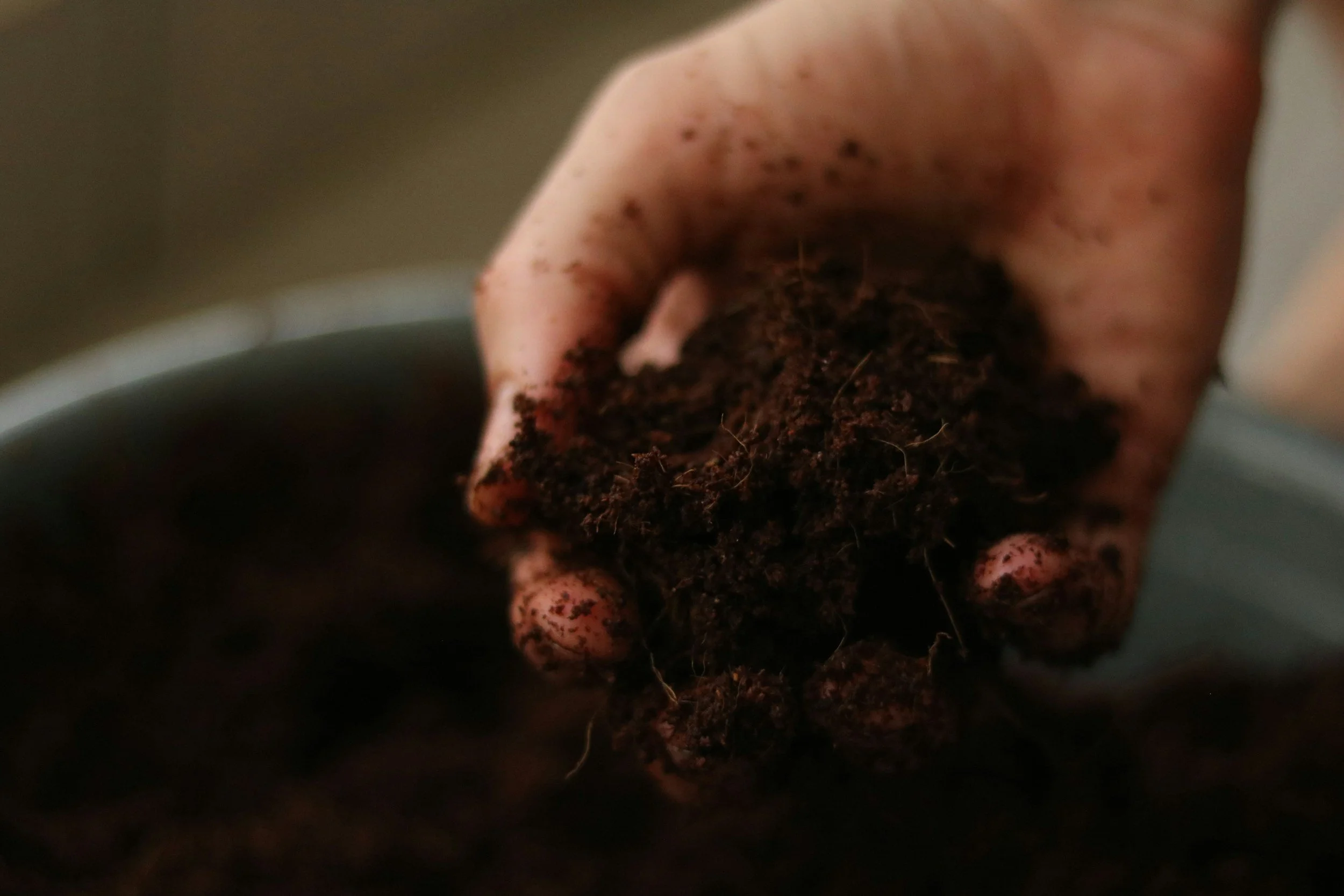
Most landscape problems trace back to the same place.
THE SOIL
We see it on almost every site we walk. Compacted ground that sheds water instead of holding it. Plants that struggle no matter how often they get fed. Beds that need constant inputs just to look alive. The instinct is to treat each symptom. Add a plant. Add a product. Add more water.
Here's what I know to be true. If you fix the soil, most of those problems fix themselves.
The soil is the whole system
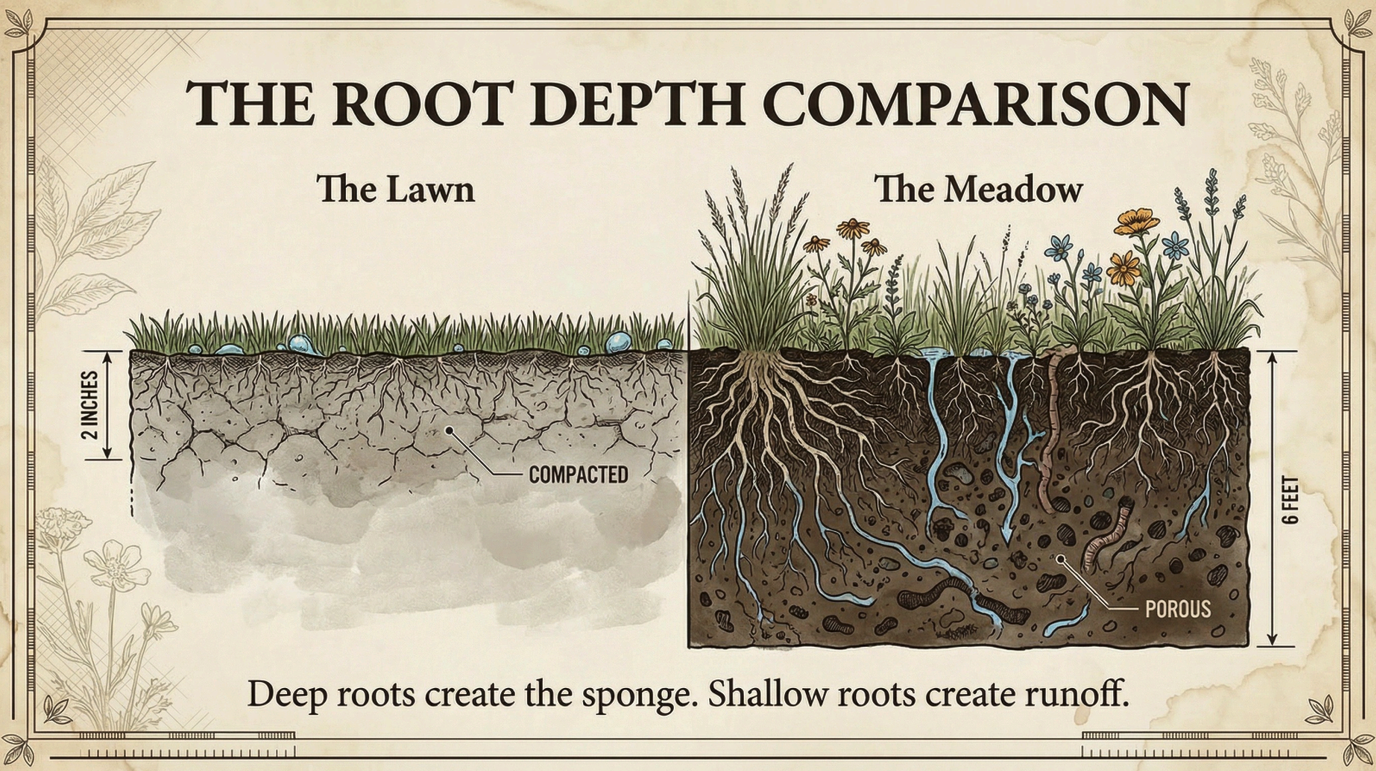
Showing the importance of diversity and different root systems to maintain healthy soil and improve hydrology, compared to lawn turf.
Soil is not dirt. It is a living thing, and a dense one. One teaspoon of healthy soil holds billions of microorganisms, more than there are people on earth. That life is what moves nutrients into roots, builds structure, and holds water in place.
When the biology is thriving, the soil works for you. It feeds plants. It soaks up rain and releases it slowly. It cools the ground it sits on. When the biology is gone, you are left renting all of those functions from a bag or a hose.
The water piece is the one I come back to most. Every one percent of organic matter you build into soil lets an acre hold about twenty thousand more gallons of water. That is not a small number. That is the difference between a landscape that drinks a storm and one that sends it down the street. It is why our whole approach starts the same way. We plant the water first.

Better soil,
better food
This matters beyond the yard. Our food has been getting thinner for decades. A University of Texas analysis of USDA records found that common vegetables carry measurably less iron, calcium, and vitamin C than they did in the 1950s, with some nutrients down by more than a third. The main driver is how we grow. We bred plants for size and speed, and asked tired soil to keep up.
Living soil is the correction. Food grown in biology-rich ground, close to where you eat it, is food with more to give. You do not need a farm to do this. You need a few good beds and healthy soil under them.
Two ways in
People usually come to soil building from one of two starting points, and the right move is different for each.
If you are starting from bare ground, you have the most freedom. Build it right once. Test first so you know what you are working with. Add compost. Keep the ground covered. And go easy on the tiller. We do not fork or till our perennial and ornamental beds at all. We auger a hole for each plant and disturb only that pocket. For food-production beds, one single till to establish the bed is fine, and then we stop. Every extra pass burns the organic matter you are trying to build.
If you already have a planted landscape, the rule flips. Do not dig. You build these soils from the top down and let the soil life carry it in. Top-dress with a thin layer of compost. Mulch, and leave your leaves where they fall. Feed the biology with a compost extract. Then get out of the way.
Grow what belongs where you are
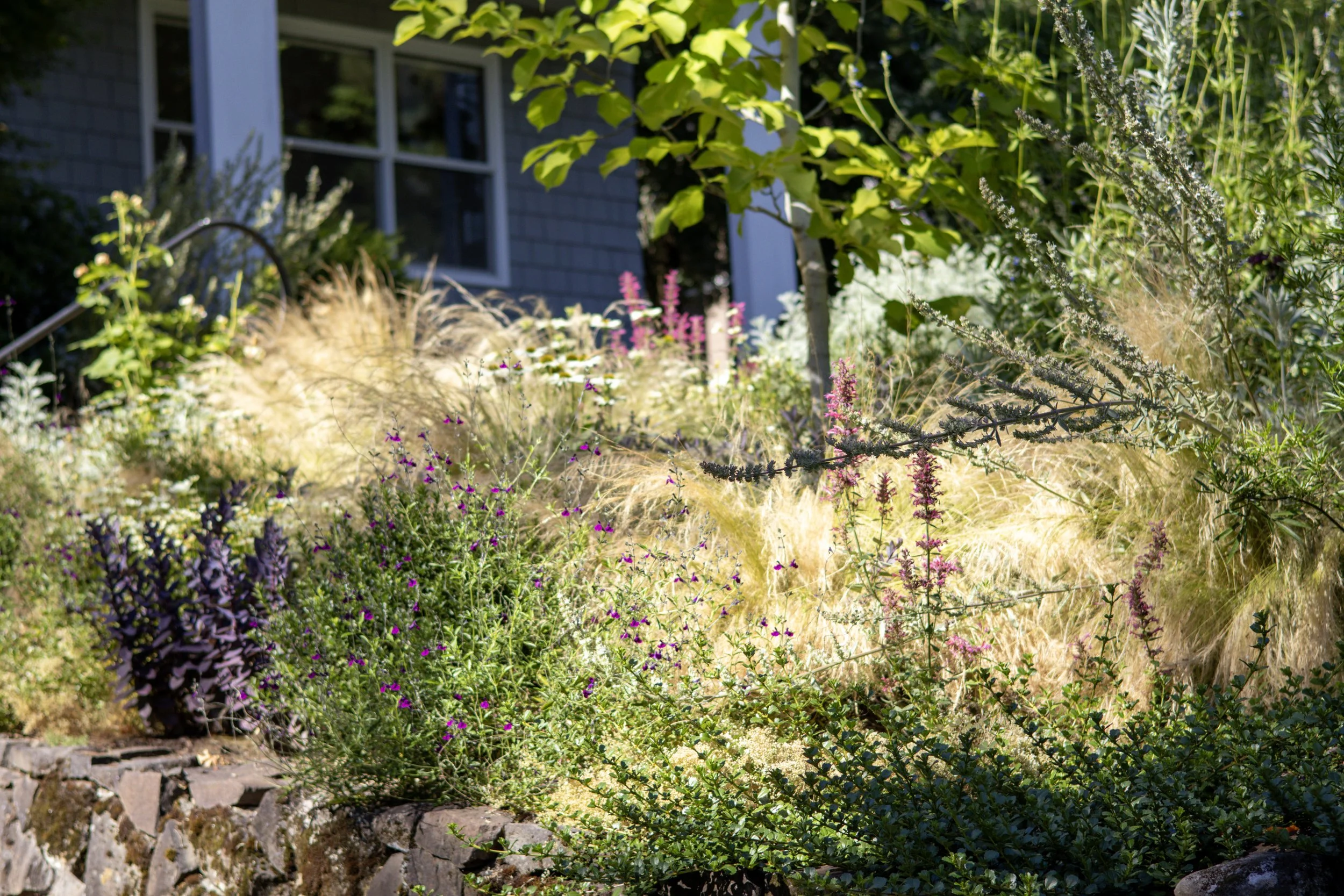
A converted front lawn into a thriving meadowscape in our Lake Oswego project. Packed full of native plants, climate adapted species, and layers of textures and color.
The plants you use to build soil should belong to your place. Your ecoregion, not your state line, is the real guide. A cover crop that thrives in the wet Willamette Valley is the wrong choice for the dry east end of the Columbia Gorge, eighty miles away.
Native lupines fix nitrogen and heal disturbed ground across much of our region. Native bunchgrasses like Roemer's fescue and bluebunch wheatgrass hold soil and steady slopes. The right list shifts as you move from the coast to the valley to the high desert. When in doubt, ask a local extension office or native plant society one simple question. Is this plant native to my ecoregion, or just sold here?
Protect the soil during the build
The real damage to soil usually happens during construction, not during care. Heavy equipment compacts the ground. Grading strips topsoil and hauls it away. A site can be harmed before a single plant goes in.
So we protect the soil first. We fence off a limited work zone and keep equipment on ground we plan to pave anyway. We stockpile the site's own topsoil and put it back. We decompact before we plant, and we shape the land so rain slows down and soaks in. This is regenerative construction, and the research supports it. Landscapes managed this way build topsoil measurably over time, rather than losing it.
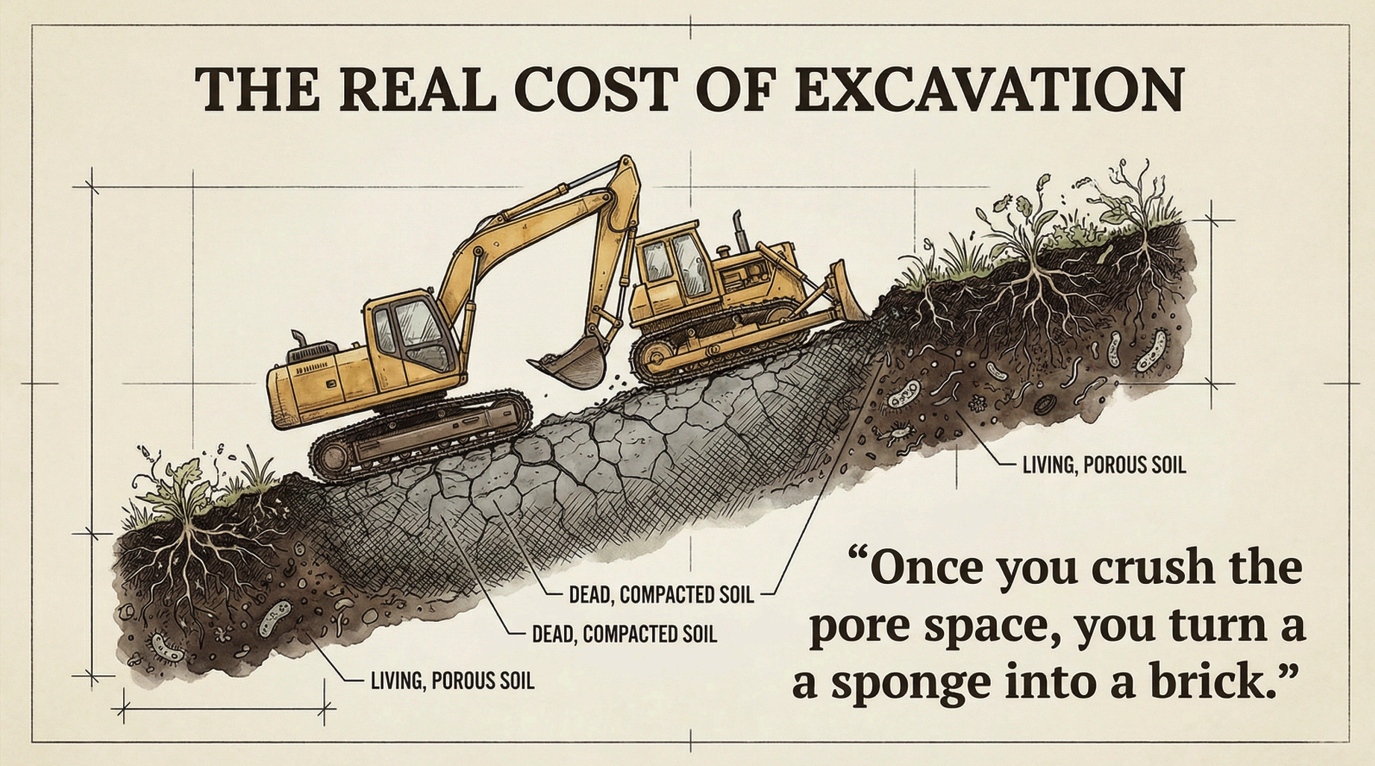
Diagram showing the impacts of construction on soil- the Dry Sponge effect
Where to start
You do not have to do all of this at once. Pick one bed. Cover it. Feed the life underneath it. Watch what happens over a season.
We put together a home soil-building checklist that walks through all of it. Bare ground and planted. Native cover crops for the areas we serve, and the questions to ask if you are somewhere else. It is yours to use.
And if you are planning a project and want a partner who builds this way from the ground up, we would love to talk it through. Email hello@be.land to set up a garden chat, or visit be.land to connect.
Start with the soil. Everything good follows from there.
Take me to the guides
Everything we build starts underground. Before a single plant goes in, we're thinking about where water moves, what the soil is doing, and how the whole system will hold up in year thirty, not just at install.
These are the same guides we use with our own clients.
Ready to talk about your site? Schedule a Garden Chat
Checkout the Land Language Podcast to learn from those changing the industry. Listen here
Join us for our upcoming speaking engagements Here

Read about the health impacts of soil under your nails, among other benefits your yard can provide.
Sources
Nutrient decline in vegetables: Davis et al., "Changes in USDA Food Composition Data for 43 Garden Crops, 1950 to 1999," Journal of the American College of Nutrition, 2004. https://doi.org/10.1080/07315724.2004.10719409
Healthy Soils are High in Organic Matter: USDA Natural Resources Conservation Service. https://www.nrcs.usda.gov/Internet/FSE_DOCUMENTS/nrcs142p2_053264.pdf
Regenerative topsoil building: Macray and Montgomery, "Trends in soil organic matter and topsoil thickness under regenerative practices at the University of Washington student farm," PeerJ, 2023. https://peerj.com/articles/16336
Native plant guidance: OregonFlora, USDA NRCS Plant Materials, OSU Extension, and Washington DNR
FAQ- Start with the Soil
-
Healthy soil is alive. A single teaspoon holds billions of microorganisms, more than there are people on earth. That biology is what moves nutrients into roots, builds soil structure, and holds water in place.
-
Every one percent increase in organic matter lets an acre of soil hold about twenty thousand additional gallons of water, based on USDA Natural Resources Conservation Service data. That capacity is why soil-building starts with planting the water first.
When water is designed first, plants go into conditions they can actually thrive in. Irrigation is sized for what the site and plant palette actually need, not default coverage. Grading directs water away from structures and toward infiltration zones. The result is a landscape that establishes faster, requires less intervention, and gets better over time rather than degrading.
Designing plants before water is designing for the day of completion. Designing water first is designing for year 3, year 10, and year 30.
-
Yes. A University of Texas analysis of USDA food composition records found that common garden vegetables carry measurably less iron, calcium, and vitamin C than they did in 1950, with some nutrients down by more than a third. Rebuilding soil biology is part of reversing that decline.
At Blueprint Earth, we assess infiltration based on actual soil composition, not assumptions from a visual walk-through. Soil texture, compaction depth, organic matter content, and existing drainage patterns all factor in. A sandy loam infiltrates at a very different rate than a compacted clay subsoil, and designing as if they're the same produces systems that fail.
For complex sites or projects with significant impervious surface, we work with grading analysis and site-specific stormwater assessments to ensure bioretention zones are sized to handle the actual load. Oregon has specific standards for stormwater management, and our designs meet or exceed them.
-
Generally no. Perennial and ornamental beds shouldn't be tilled at all…auguring a hole for each plant limits disturbance to that single pocket. Food-production beds can be tilled once to establish the bed, but repeated tilling burns off the organic matter you're trying to build.
-
Compacted soil loses its ability to absorb water. When soil structure collapses, the pore spaces that allow water to move through are eliminated. Rain hits the surface and runs instead of infiltrating.
Heavy equipment during construction is one of the most common causes. Equipment compaction can collapse soil structure 12 to 18 inches deep. After that, you're not working with topsoil anymore. You're working with something that functions more like subsoil, and no amount of surface planting fixes that without addressing the underlying structure.
At Blueprint Earth, equipment and staging zones are planned before construction begins to minimize compaction beyond the build footprint. After construction, we reintegrate organic matter and use compost-based amendments to restore microbial communities and water retention. Healthy soil biology is what makes infiltration possible over the long term.
-
Regenerative landscape design is an approach that improves a site's ecological function over time rather than simply maintaining it. The goal is a landscape that builds soil health, manages stormwater on-site, supports real habitat, and reduces or eliminates the need for chemical inputs as it establishes.
The distinction from conventional landscaping is directional. Conventional landscapes often degrade over time: soil compacts, inputs increase, maintenance costs rise. A well-built regenerative landscape moves in the opposite direction. Soil biology improves. Native plant communities establish and self-support. Stormwater infiltrates rather than running off. The landscape becomes more functional, not less, as it matures.
At Blueprint Earth, regenerative design is not a marketing term. It's a set of specific practices applied to every project: water-led design, soil assessment before disturbance, native plant selection for function, organic soil amendments, and construction methods that protect what's already working underground.
-
Bare ground allows more freedom: test the soil, add compost, keep it covered, and till minimally. An already-planted landscape shouldn't be dug at all, instead, top-dress with a thin layer of compost, mulch and leave leaves where they fall, and feed the biology with a compost extract.
-
The right plants depend on ecoregion, not state lines, since growing conditions can shift dramatically over a short distance. Native lupines fix nitrogen and heal disturbed ground, while native bunchgrasses like Roemer's fescue and bluebunch wheatgrass hold soil and stabilize slopes.
-
These are the questions worth asking before you hire anyone:
Do you start with a grading analysis, or do you assess drainage visually? A visual walk-through is not a grading analysis. If a designer can't tell you where water enters your site, how it moves, and where it exits, they're guessing.
How do you handle impervious surface? Any new hardscape that doesn't infiltrate increases runoff. Ask what the mitigation plan is.
What's your approach to soil before construction? If they're not assessing soil before they disturb it, they're designing without knowing what they're working with.
Do you design irrigation based on plant water needs, or do you use default coverage? Overwatering is one of the most common causes of plant failure and soil compaction.
What does the landscape look like in year 3 and year 10? If the answer is only about aesthetics, ask about maintenance requirements and input costs over time.
Are you design-build, or do you hand off to a separate contractor? When design and construction are separated, design intent often doesn't survive the build. Ask how they ensure the grading plan and stormwater design are executed as drawn.
-
Low impact development (LID) is a stormwater management approach that manages rainfall at the source rather than routing it to storm drains. The goal is to replicate a site's pre-development hydrology: infiltrate, evapotranspire, and retain water on-site rather than concentrating and conveying it off-site.
In residential landscaping, LID practices include rain gardens, bioswales, permeable paving, cisterns, green roofs, and native planting that supports infiltration. Oregon and Portland specifically have stormwater management standards that align with LID principles, and many projects in our service area are subject to those requirements.
Regenerative landscape design and LID overlap significantly. Both prioritize keeping water on-site, restoring soil function, and reducing the burden on municipal stormwater infrastructure. The difference is that regenerative design extends the framework to include soil biology, habitat, plant ecology, and the long-term health of the landscape system, not just stormwater compliance.
-
The difference is directional. Conventional landscaping tends to degrade over time. Regenerative landscaping improves.
Conventional landscaping typically relies on synthetic fertilizers that feed plants but bypass soil biology. Landscape fabric that suppresses weeds but also suppresses soil function. Turf that requires constant inputs (water, fertilizer, aeration, pesticides) to stay viable. Impermeable hardscape that increases runoff. Designs optimized for appearance at installation, not performance over time.
The result is a maintenance treadmill. Inputs increase as soil biology declines. Drainage problems compound. Remediation costs accumulate.
Regenerative landscaping starts with the site: its hydrology, its soil, its existing biology. Design decisions are made to work with those systems, not override them. Native plants are selected for function. Soil is protected during construction and restored after. Stormwater is managed on-site. The landscape is designed for what it becomes, not just what it looks like on day one.
The lifecycle cost difference is significant. A drainage remediation in Portland runs $8,000 to $25,000 or more per cycle. Conventional lawn maintenance compounds annually. A regenerative landscape, designed and built correctly, reduces those costs over time as the system matures.
You own a functioning ecosystem, or you own a maintenance problem. That's the choice.
-
The Blueprint Earth Regenerative Standard is the framework we apply to every project. It covers six pillars: Water, Soil, Plants, Materials, Wildlife and Habitat, and Process.
Water: Every project begins with a site-specific stormwater assessment. Stormwater is retained or infiltrated on-site where possible. No net increase in impervious surface without a mitigation plan that meets or exceeds Oregon standards.
Soil: Soil is assessed before the site is disturbed. Equipment zones are planned to minimize compaction. After construction, organic matter is reintegrated and compost-based amendments restore the soil food web.
Plants: Native plants are selected for function first, appearance second. Right plant, right place, based on actual site conditions: hydrology, soil type, sun exposure, and intended use.
Materials: Permeable hardscape where appropriate. Local sourcing prioritized. No pressure-treated lumber in soil contact zones. No landscape fabric.
Wildlife and Habitat: Pollinator corridors, canopy layering, and bird habitat are considered in planting design, not added as afterthoughts.
Process: How we build is part of the product. Construction methods must honor design intent. That's why we're design-build. When design and construction are in conversation on every project, the standard holds.
For those within the industry:
You know the work matters. You've seen what a well-designed regenerative landscape does over time, how it improves, how it holds water, how it builds soil, how it becomes something the client didn't know they were capable of stewarding.
The problem isn't your instincts. It's the infrastructure around them.
Pricing that feels like guessing. Client conversations where you explain the right approach and still lose the bid to a conventional contractor. A process that works but lives entirely in your head, impossible to hand off or scale. No framework for any of it, because no school built one.
Rooted by Land Language Institute is that framework.
Six modules built for landscape designers, ecological designers, and design-build contractors who are already doing the work and want to do it better. Ecological design, business fundamentals, and the client communication that actually moves people, all in one place. Three tiers. Lifetime access. Built by Brit Sastrawidjaya, founder of Blueprint Earth, from fifteen years of building a seven-figure regenerative practice without a roadmap.
We're getting close to opening enrollment. Stay tuned for the official launch announcement, including how to get on the waitlist and lock in early access pricing before it goes public.
More soon.