
Your Fall Cleanup Isn't a Wildlife Issue. It's a Hydrology Issue.
Every fall, the same advice cycles through gardening media: leave the leaves, don't cut back your perennials, let the seed heads stand for the birds. It's good advice. It's also incomplete.
Most of what's written about "leaving the leaves" frames it purely as a pollinator and wildlife story. Overwintering insects need shelter. Birds need seed heads. That's true, and it matters. But it's not the reason we tell our clients to resist the urge to strip their beds bare every October.
We tell them because what's happening under that leaf layer is a hydrology story, and it's the one nobody's writing about.
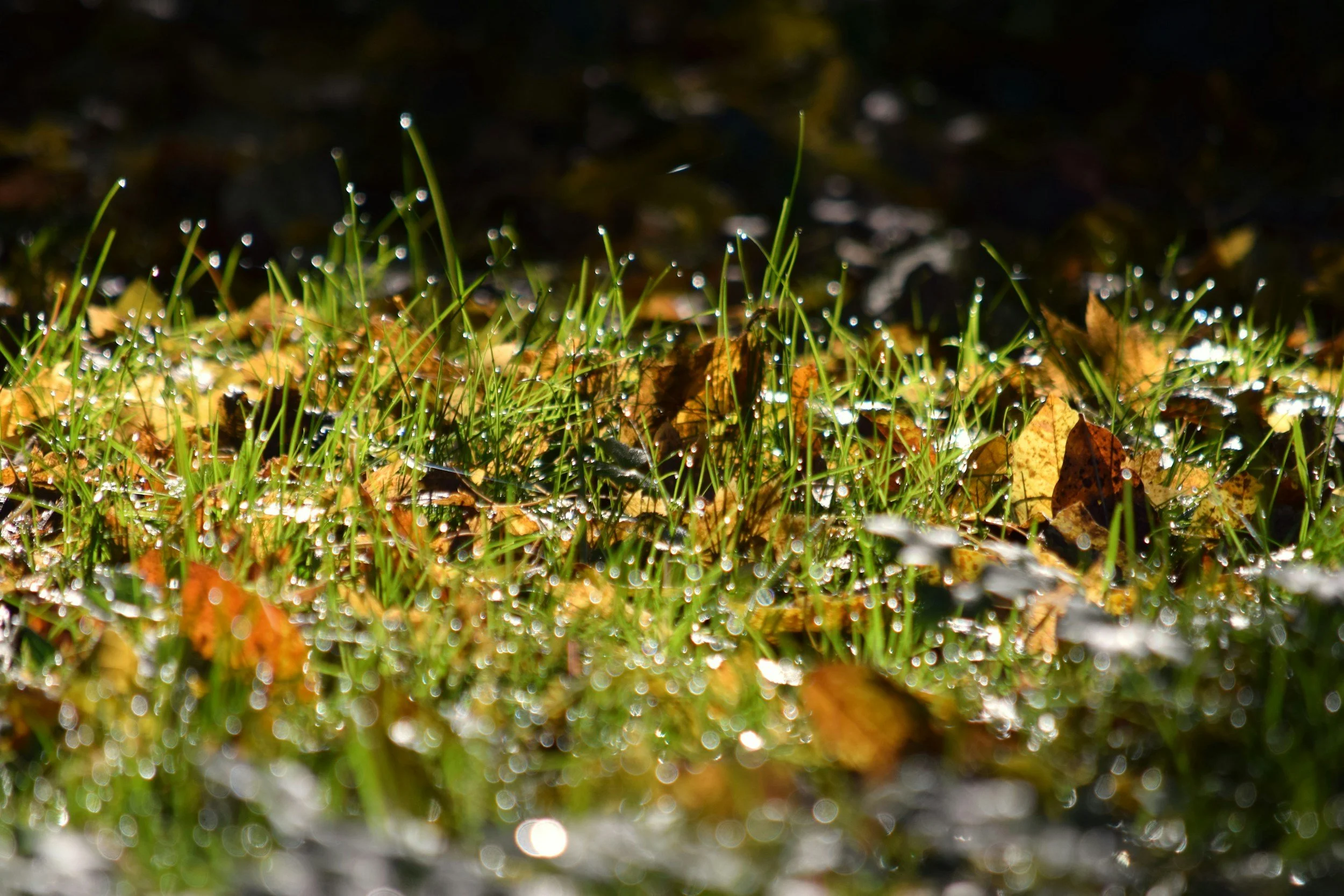
Fallen leaves in a lawn
What Bare Soil Actually Costs You
Here's what a fall cleanup crew with leaf blowers is actually doing to your property: removing the material that determines whether your soil can absorb water or just sheds it.
Hummingbird perched on a tree in Lake Oswego
This isn't abstract. Peer-reviewed hydrology research on litter layers shows a direct, measurable relationship between organic litter mass and a soil's capacity to intercept and infiltrate rainfall. In forested and vegetated systems, litter cover consistently increases infiltration rates, reduces soil bulk density over time, and increases pore volume, the physical space water needs to move down into the soil profile instead of running off the surface (PLOS ONE, Li et al.).
A 2023 study using field lysimetry found the same mechanism: leaf litter acts as a porous interface between mineral soil and open air, and as it breaks down, it directly increases the soil's ability to take in water rather than lose it to runoff or evaporation (Forests journal, Kim et al.). Organic mulch studies have quantified this further. At higher application densities, organic cover increased water retention by 11 to 23 percent and water absorption by 7 to 16 percent of gross rainfall, compared to bare or lightly covered soil (Soil Systems, Lopes et al.).
Translated out of the research and into your backyard: every leaf you blow off your beds and bag for the curb is a small reduction in your property's ability to absorb the next rainstorm. Do that across an entire landscape, every fall, for years, and you're not just losing habitat. You're actively degrading the one system that determines whether your yard floods, erodes, or recharges the water table underneath it.
This Is Why We Plant the Water First, Even in the Off-Season
At Blueprint Earth, water-first design doesn't stop when the growing season ends. Soil infiltration capacity isn't something you calculate once during a site read and then forget. It's a living system that builds or degrades based on what you do, or don't do, to the ground every season.
When we design a landscape, we're accounting for how the soil will perform in year 3, year 10, year 30. A fall maintenance routine that strips organic matter off the beds every October is quietly working against that timeline. It's removing the exact material that would otherwise be feeding soil biology, building porosity, and improving the infiltration rate that keeps your property resilient during PNW's increasingly erratic rain patterns, wet atmospheric river events followed by longer dry stretches.
Conventional maintenance treats leaf litter as debris. We treat it as infrastructure.
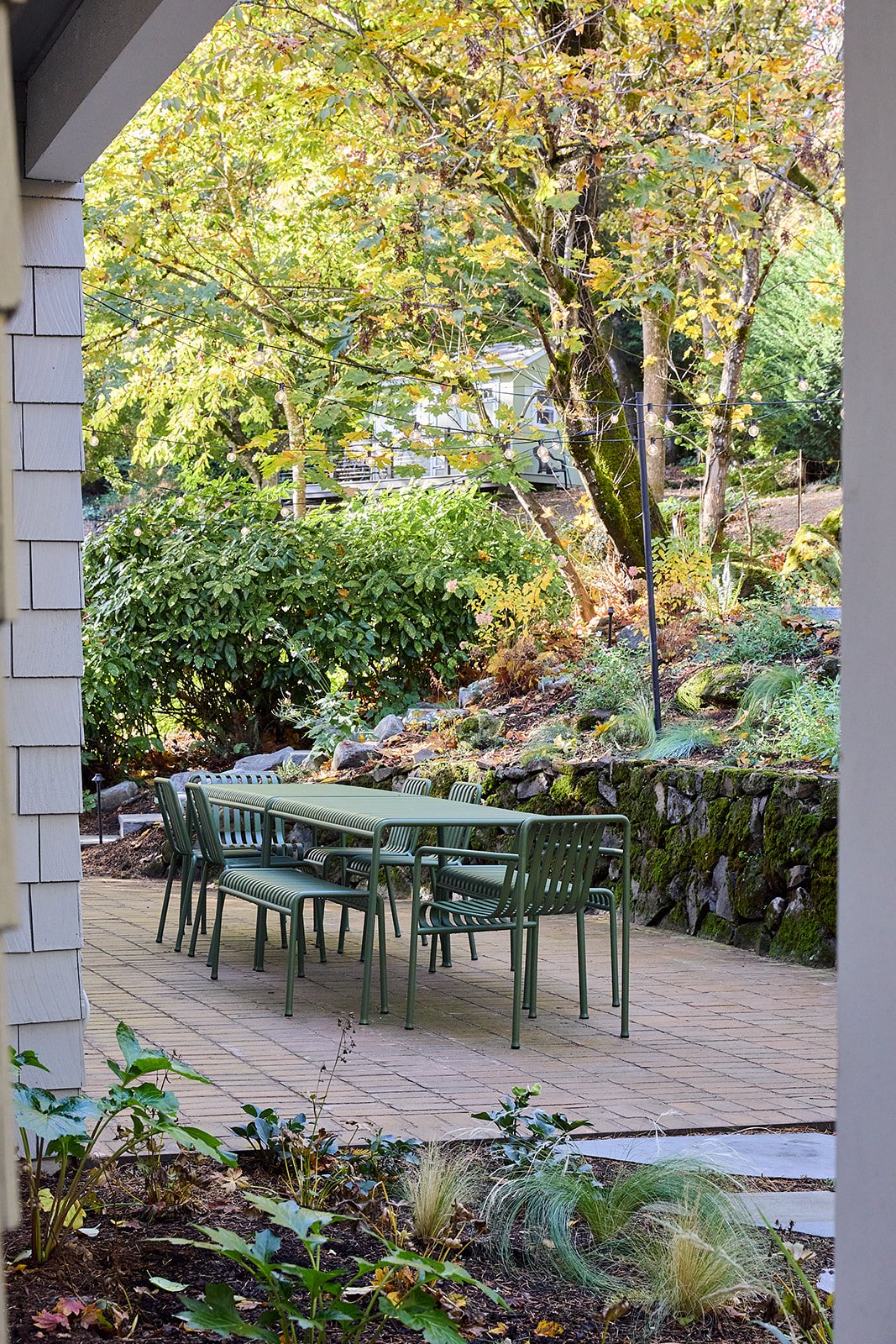
Lake Oswego backyard in the fall
What To Actually Do With Your Beds This Fall
Leave leaf litter in planting beds and under trees and shrubs, at a depth of roughly 2 to 3 inches. This is enough to suppress weeds and feed soil biology without smothering crowns.
Keep leaves off turf areas and hard pathways. This isn't an all-or-nothing practice. Move leaves off lawns and walkways into beds where they'll actually do hydrological work.
Leave standing perennials and ornamental grasses through winter. Beyond wildlife habitat, standing stems slow surface water movement during heavy rain events and reduce splash erosion on exposed soil.
Hold off on the "tidy" cutback until late winter, once new growth starts to emerge from the crowns. Cutting in September removes material that's still doing active hydrological and ecological work.
If you have diseased foliage, remove that selectively. This is the one legitimate exception. Fungal issues like powdery mildew can overwinter in infected material and reinfect plants next season. Clean material stays. Diseased material goes.
The Bigger Point
The "leave the leaves" conversation happening across gardening media right now is a good instinct pointed at an incomplete reason. Pollinator habitat is real. But if that's the only argument you're making to a client, you're leaving out the mechanism that actually determines whether their landscape survives the next decade of PNW weather volatility: soil that can absorb water instead of shedding it.
We built our business on reading a site's hydrology before we ever spec a plant. Fall maintenance is where that same thinking either compounds your soil's performance, or quietly erodes it, one bare October at a time.
Ready to talk about your site? Schedule a Garden Chat
Checkout the Land Language Podcast to learn from those changing the industry. Listen here
Join us for our upcoming speaking engagements Here
FAQ
Won't leaving leaves on my lawn kill the grass?
On turf, yes, a thick mat can smother grass and slow spring green-up. That's why this isn't a blanket "never rake" rule. Keep leaves off lawns and pathways, and direct them into planting beds and under trees where they can do their job instead.
What about ticks and pests near the house?
Keep leaf litter and mulched zones a few feet back from your home's foundation and any high-traffic areas where kids or pets play. The hydrological and habitat benefits apply to your planting beds, not the strip of ground against your siding.
Is this the same as never doing fall cleanup?
No. It's a shift in what you clean up and when. Remove diseased plant material and clear debris off hardscape and turf. Leave organic matter in your beds to do the work it's designed to do until a proper late-winter cutback.
How does this connect to drainage problems I already have?
If you're dealing with standing water or a soggy backyard every winter, the condition of your soil's organic layer is part of that story. Compacted, stripped soil infiltrates poorly no matter what's planted in it. Rebuilding organic matter is one lever. Site grading and drainage engineering are usually the other. If you're seeing consistent pooling, that's worth an actual site evaluation rather than a fall maintenance tweak alone.
When should I actually cut everything back?
Late winter, generally once you see consistent daytime temperatures and new growth emerging from the crowns. That timing protects overwintering insects and gives your soil the maximum benefit from a full season of organic cover.
Research sources cited:
Li, Niu, Xie. PLOS ONE (2013). Litter hydrological properties and infiltration. https://journals.plos.org/plosone/article/file?id=10.1371/journal.pone.0070328&type=printable
Kim et al. Forests (2023). Water Retention Capacity of Leaf Litter According to Field Lysimetry. https://doi.org/10.3390/f14030478
Lopes et al. Soil Systems (2025). Assessment of Water Retention and Absorption of Organic Mulch Under Simulated Rainfall. https://doi.org/10.3390/soilsystems9010004
Scientific Reports (Nature), 2021 https://www.nature.com/articles/s41598-021-85343-x
Hydrology and Earth System Sciences (HESS), 2026 https://hess.copernicus.org/articles/30/4305/2026/hess-30-4305-2026.pdf