

The one thing that determines whether your landscape vision becomes a living, lasting reality, and what to understand before you invest in your outdoor space.
You have been carrying a vision of this in your mind for a while now. Maybe it's the morning when you can finally have coffee outside, in a garden that feels alive around you, the kind of quiet that restores you before the day starts. Maybe it's the backyard that becomes the place everyone gravitates to, where your kids want to be, where guests arrive and immediately drop their shoulders. Maybe it's simply the feeling that your home, all of it, finally matches the life you are living.
That version of your outdoor space is real. It is a design opportunity. And you are closer to it than you might think.
Before you get there, there is one thing most homeowners never consider, and most landscape companies never bring up. It will determine whether your investment in that vision thrives for decades or quietly struggles from the start.
It's what happens when it rains.
And in Portland, that is not a rhetorical question. This region gets 37 inches of rain a year across 155 days of rain. That is not an edge case to plan around occasionally. That is the baseline condition your landscape lives in for nearly half the year. A stormwater strategy here is not a nice-to-have add-on to the design. It is the design.
Where You Are Right Now
You may already be noticing things. A low spot that stays soggy longer than it should. Plants that never quite thrive. A corner of the yard that pools after every rain. A nagging feeling that something underneath is not quite right, even if you cannot name it.
Or maybe you haven't noticed anything yet, because the problem is invisible. Water moves in the wrong direction silently, for years, before the signs become obvious. By the time a homeowner sees the symptoms, the damage is already underway: in the soil, at the foundation, in the plants that never establish properly because they were never in the right conditions to begin with.
Either way, you're likely standing on a property with untapped potential and an invisible system, your land's hydrology, that has never been properly worked with. That's exactly where transformation begins.
What Your Land Is Doing Right Now (Whether You Know It or Not)
Every time it rains, your property is making decisions. Water is moving somewhere. The question is whether it is moving the way it should, or quietly working against you.
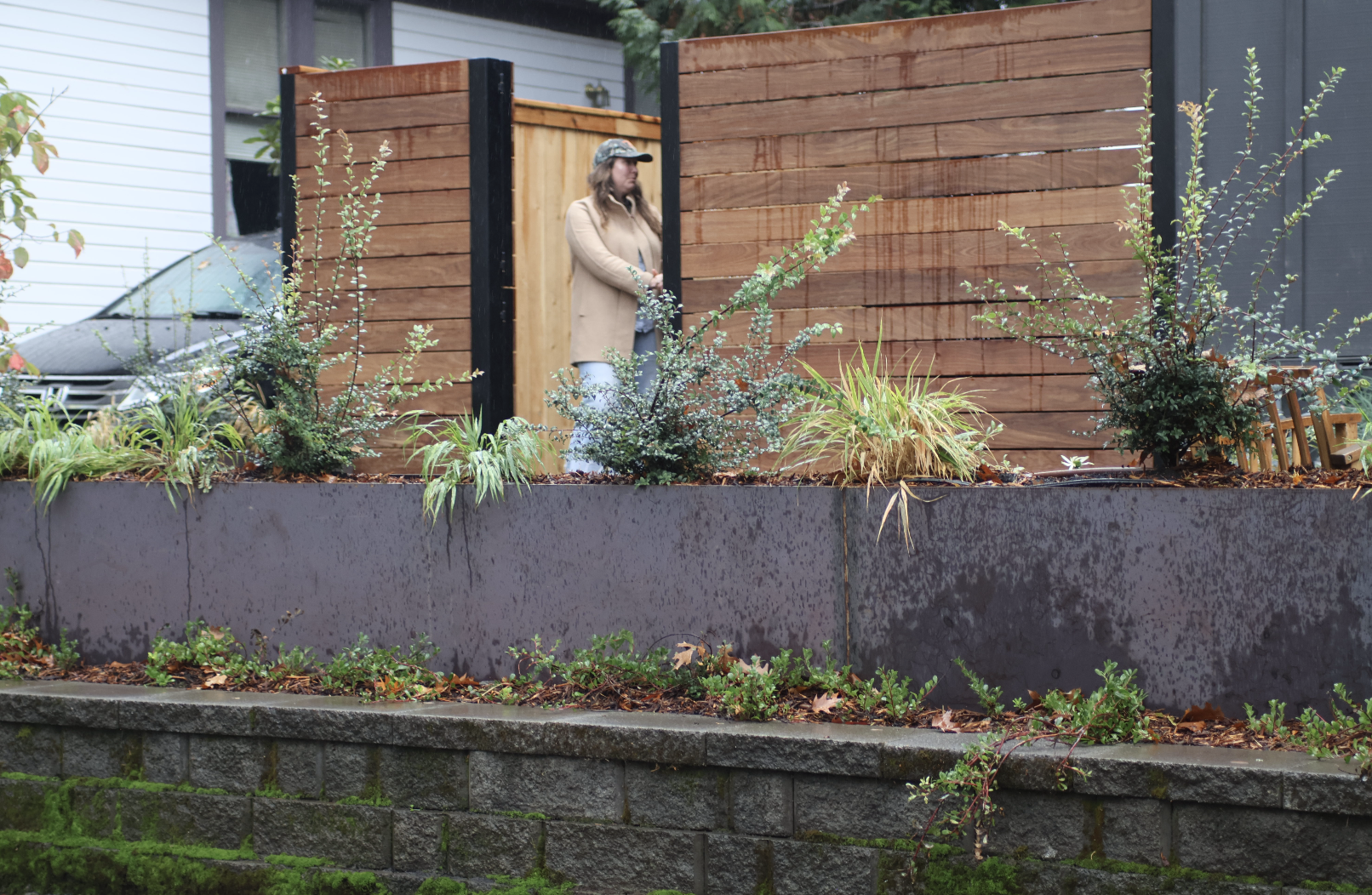
Grading is the shaping of your land: how the surface is sloped and contoured to direct water. On a well-graded property, water moves away from your home naturally. It flows at the right rate, not fast enough to erode the soil, not slow enough to pool and saturate. It soaks gradually into the ground, supporting plant life and replenishing the water table. Your foundation stays dry. Your plants establish deeply. Everything above the surface gets to become what it was designed to be.
On a property with grading problems, the opposite is true. Water moves toward the house instead of away from it. It sits in low spots. It compacts the soil it crosses. Over time it puts quiet pressure on the very foundation your home is built on. No matter how beautiful a landscape looks in its first season, it will always struggle if the ground beneath it was never set up to support it.
What This Costs You If It Goes Unaddressed
Grading carries real financial weight.
Properties with drainage and grading problems can see meaningfully reduced resale value, with the discount scaling with severity, from a few percentage points for minor, easily-corrected issues to well into double digits for visible foundation or structural water damage. On an $800,000 home, even the low end of that range is real money left on the table before a buyer makes an offer.
A correctly graded property eliminates that penalty entirely. A well-executed landscape project adds real value on top: Virginia Tech Cooperative Extension research on landscape valuation found that upgrading a home's landscape from good to excellent increases perceived value by 6% to 7%, and moving all the way from average to excellent can add 10% to 12%.
And because plants mature and root systems deepen over time, a landscape built on the right foundation is one of the only home improvements that genuinely appreciates. A kitchen remodel peaks the day it is finished. A properly graded landscape gets better every year.
The Three Bandaids
(And Why Each One Fails)
Before we get to what actually works, it's worth naming what doesn't, because these are the default moves almost every contractor reaches for first.
The Pop-Up Emitter. The standard advice: connect the downspout to a leaf trap, run solid pipe eight inches below grade, and terminate at a pop-up emitter, an outlet, a sewer, or a drywell. It sounds tidy. In practice, the emitters clog with debris, the water freezes in the pipe come winter, and when they do work, they just dump water onto the sidewalk, which is its own liability. Underneath all of it is the same core mistake: the system treats water as waste to be disposed of, not a resource to be used.
The Dry Well. This is what most jurisdictions consider the "standard of care," and it satisfies code compliance. But compliance and performance are not the same thing. A dry well takes roof runoff and buries it in a gravel-lined sump, often surrounded by compacted clay that traps the water below the reach of plant roots entirely. The surface landscape never sees a drop of it. That means your new plantings, the ones you're spending real money on, stay dependent on irrigation instead of the rain that's already falling on your roof.
The Sump Pump. This is the last resort, and it's telling that it's a last resort. When a basement gets dug below the water table, the standard fix is to let the water in, catch it in a channel, and pump it back out, forever. It works, until the power goes out during the storm that matters most. It relies on electricity. It relies on mechanics that burn out. And structurally, it turns a problem that gravity could solve for free into a permanent mechanical liability.
All three approaches share the same flaw: they're built to get water off the property as fast as possible. In a region with a real summer drought, that's not drainage. That's waste.
A Note on French Drains, and Why We Rarely Use Them
You will notice we did not lead with French drains. That is intentional.
French drains, subsurface perforated pipes that redirect water underground, are a common go-to in conventional landscaping. They are also a last resort in ours. In clay-heavy soils, which describes much of the Portland area, they fail in a specific, predictable way: the gravel envelope clogs with fine sediment over time, and because the pipe is buried below a compacted clay layer, the system never actually infiltrates water into the ground. It just moves water laterally to somewhere else on, or off, the property. That's a redirection, not a solution.
And like the other bandaids, it exports water off your property entirely, which means you lose it. In the Pacific Northwest, we have real summer drought. Every drop that falls during the wet season is a resource, one that, if handled well, can be moved through your landscape and deposited exactly where your plants need it most. Not into a drywell. Not down the sidewalk into the storm drain. Into the root zone of the garden you are trying to grow.
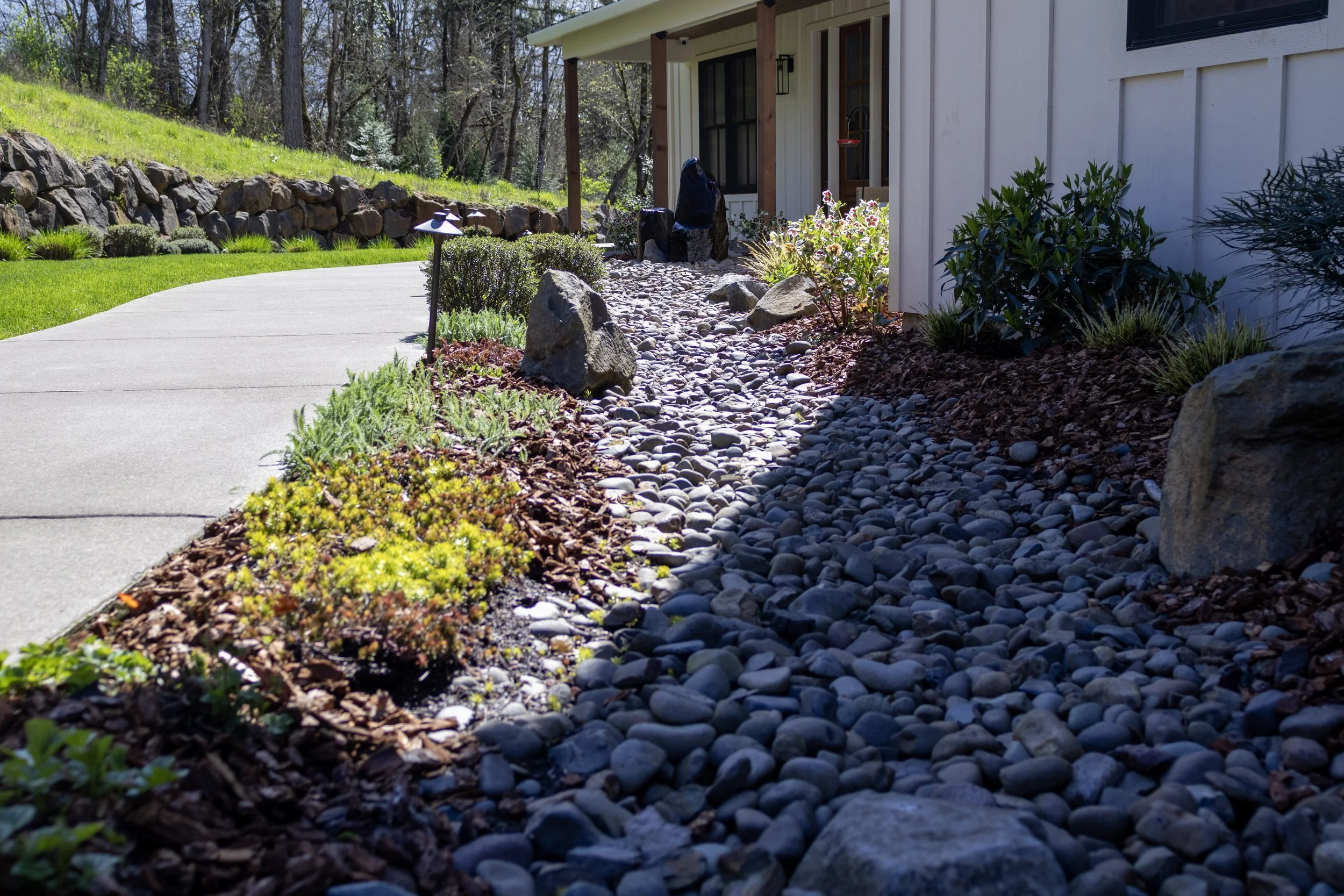
When we design with surface runoff solutions first, swales, rain gardens, berms, and thoughtful grading, we are not just managing drainage. We are building an irrigation strategy. We are setting your property up to use the rain it receives rather than shed it as fast as possible.
The result is measurable. Irrigation bills come down. Plant establishment rates go up. A landscape planted with the right natives, ones selected to thrive in your specific conditions and support pollinators from early spring through late fall, becomes genuinely self-sustaining in ways a conventionally irrigated garden never will.
A French drain solves a problem. A well-designed stormwater system creates an asset.
We do reach for subsurface solutions when surface options genuinely cannot do the job: foundations under extreme pressure, hardscape constraints, sites where there is simply nowhere for water to go above ground. But it is never our first move.
In a regenerative landscape, stormwater management does more than protect your home. It transforms your property into something that actively gives back, reducing your water bill, increasing plant health, supporting bees and native pollinators through seasons when most gardens have nothing to offer. Your property stops taking from the land. It starts healing it.
Your Property Has a Water Story. It Can Be a Good One.
Stormwater management shapes how water behaves across your entire property, from the moment it falls until it soaks in or leaves the site. Grading is the foundation of that system, but stormwater management includes everything water touches along the way.
When your property's water story is designed with intention, you stop fighting nature and start working with it. Rain becomes replenishment instead of damage. Your soil stays healthy. Your plants establish deeply because their root zones are neither drowning nor parched. The landscape you have been imagining has room to actually become itself.
Depending on your site, a stormwater strategy might include:
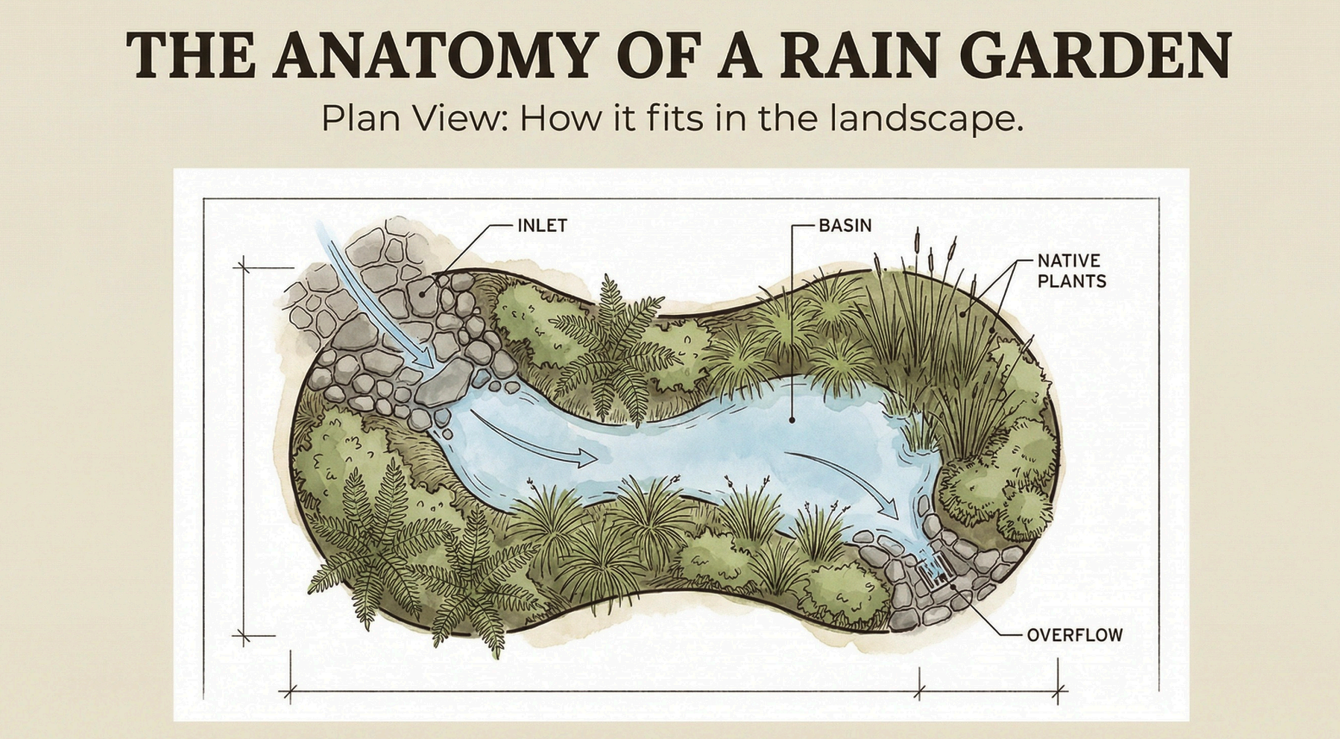
Rain gardens -- planted depressions that capture and filter runoff from roofs and hard surfaces, turning drainage into something beautiful and functional
Bioretention swales -- gentle channels with deep-rooted natives that slow water down and let it infiltrate gradually, exactly where plants need it most
Permeable paving -- surfaces that let water pass through rather than sheet off into overtaxed municipal drains
Native plantings -- deep-rooted species that dramatically increase your soil's capacity to absorb and hold water over time, while providing habitat and blooms for pollinators through the shoulder seasons
Think of your soil like a kitchen sponge. When it's bone dry, the way soil gets after a long summer, water beads up and runs off immediately. That's a hydrophobic surface, and it's the default condition of compacted, construction-damaged soil.
A rain garden works differently because it keeps the soil structure open and living. It acts like a damp sponge: ready to absorb water the moment it hits the ground instead of shedding it. The first rain event after installation is the most critical test of whether a system was actually built right.
The difference below the surface is dramatic. A conventional lawn typically has roots reaching about two inches down into compacted soil, which is why lawns pool and puddle. A planted meadow or rain garden, by contrast, sends roots down as far as six feet, building a porous network that channels water deep into the ground instead of letting it sit on top. Deep roots create the sponge. Shallow roots create the runoff.
There's a smaller, stranger piece of this worth knowing about: mycorrhizal fungi. These beneficial fungi attach to plant roots and can increase their effective surface area by roughly 100 times, turning the root zone into a massive underground sponge that keeps working long after the plants themselves have established.
This is also why heavy construction equipment is such a real threat to a site's long-term drainage performance, not just to the plants sitting on top of it: once you crush that pore space in the soil, you turn what could be a sponge into a brick, and it does not recover on its own.
We aren't just managing water when we build these systems. We're rebuilding the soil's ability to drink.
The Same Budget, a Completely Different Result
Here's the number most homeowners never hear: a standard dry well and a properly designed rain garden often cost the same, somewhere in the neighborhood of $15,000 for a typical residential install. The line items are just allocated differently.
A dry well's budget goes to excavation, concrete rings, drain rock, and piping and labor. A designed rain garden's budget goes to fine grading, amended soil, plants and mulch, and labor and design.
Same total spend. Completely different outcome.
One is buried infrastructure you'll never see again, doing the bare minimum to stay out of trouble with code. The other is a landscape amenity that gets more beautiful every year, actively improves your soil, and waters your plants for free.
You are very likely going to spend the money either way. The only question is what you get for it.
Choosing the dry well because it feels like the safe, standard choice actually costs you something less visible: new plantings need consistent moisture to establish, and a rain garden delivers that naturally, while a dry well forces those same plants to rely on potable irrigation instead. Construction compacts and damages soil structure, and deep infiltration through living plant roots is the only real way to rebuild it, a process a dry well bypasses completely by routing water six feet underground before it ever reaches the root zone. And a landscape watered by deep infiltration becomes genuinely drought-tolerant over time, while one that depends on surface sprinklers stays fragile indefinitely.
Choosing the "standard" option, in other words, means building a fragile landscape by default, for the same price as building a resilient one.

The One Thing That Protects Your Investment
Grading mistakes almost never happen in the design. They happen in the gap between design and construction.
When one company draws the plan and a different company builds it, small grading decisions get made in the field, in the moment, by a crew that was not part of the original vision. A slightly different slope. A swale that gets compressed because it was inconvenient during construction. A grade break that gets interpreted loosely. Those small decisions compound. Water ends up moving in the wrong direction, silently, for years. Your landscape struggles. Your foundation is under quiet pressure. The vision you paid for does not perform the way it should.
This is also why timing matters more than most homeowners realize. There's a real point of no return on every project: once excavation and foundation work begin, your options for grading and stormwater design narrow sharply, and by the time the crew is pouring concrete, some of the best, cheapest solutions are no longer on the table. The window to solve this well is during design and permitting, before a single shovel goes into the ground.
A rain garden's rough shape, for instance, should get carved out during the initial excavation of the site, at the same time the rest of the grading work is happening, not filled back in and re-dug later once the "real" landscaping starts. That one sequencing decision alone typically saves around $1,500 in machine time, and it only works if the stormwater plan already exists before the excavator shows up.
The solution is straightforward: work with a team that designs and builds under the same roof. When the people who determine your grading plan are the same people responsible for executing it on the ground, there is no gap. There is no moment where your home's foundation is left to someone else's interpretation, and no moment where a rain garden gets missed because nobody told the excavator it was coming. What you envisioned is what gets built. The way it was designed to perform is the way it actually performs.
A Property That Heals Itself Over Time
The homeowners who invest in regenerative landscapes are not just buying a beautiful outdoor space. They are buying a property that gets better every year.
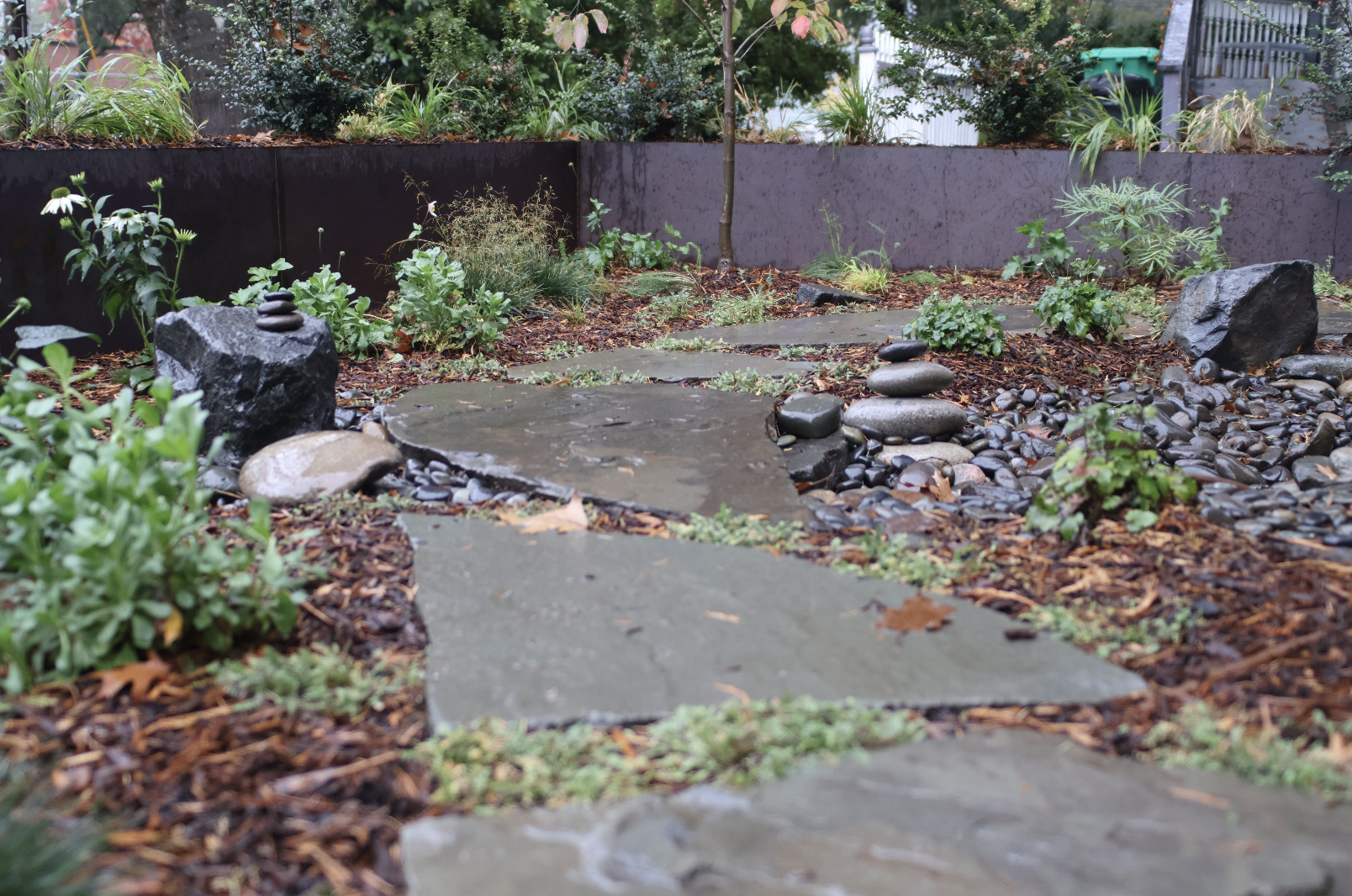
When grading and stormwater management are done well, the landscape becomes self-sustaining in ways that conventional landscapes never do. Native plants send roots four, six, eight feet into the ground, creating channels for water and air, building soil structure, reducing the need for irrigation as they tap into deeper moisture reserves. Beneficial insects and pollinators find their way in. Soil biology improves season after season. The rain garden that looked simple in year one is lush and layered by year three. The swale that was barely noticeable has become a habitat corridor.
Your investment does not depreciate. It compounds.
And you get to live in it the whole time, watching your kids grow up in a yard that is genuinely alive, hosting the gatherings that happen naturally when the outdoor space invites them, waking up to a garden outside your window that restores you before your day begins.
That is the vision of your outdoor space you have been carrying in your mind. Getting the water right is how you make it last.
Signs Your Property Is Ready for This Conversation
You do not have to have visible drainage problems to benefit from getting grading right. But here are the signs that your property is telling you something:
Water pooling in the same spots after every rain, even hours later
Soggy or saturated lawn areas that never fully dry
Moisture marks on basement or crawl space walls
Small erosion channels where soil is being carried away by moving water
Plants that struggle in spots where they should thrive
Patios, paths, or driveways that have shifted or settled unevenly
A yard that slopes toward the house rather than away
Downspouts that discharge near the foundation with no clear path away
If any of these sound familiar, grading and drainage is the first conversation to have, before plants, before patios, before any design element at all. Get the foundation right, and everything else follows.
How much does poor drainage reduce a home's value?
Poor drainage and grading problems are consistently linked to lower resale value, though the exact discount depends on severity. Estimates range from roughly 5% for minor, easily-corrected issues up to 20% or more for properties with visible foundation or structural water damage. The pattern holds across sources: buyers and appraisers treat standing water, soggy lawns, and moisture at the foundation as a red flag that gets priced in before an offer is ever made.
Does good landscaping actually increase home value?
Yes. Virginia Tech Cooperative Extension research found that upgrading a home's landscape from good to excellent increases perceived value by 6% to 7%, and from average to good by 4% to 5%. Combined, moving a landscape from average to excellent can add 10% to 12% in perceived value. Unlike most home improvements, a landscape built on correct grading continues to appreciate as plants mature.
Why doesn't Blueprint Earth lead with French drains?
French drains move water off the property entirely, which in a region with real summer drought means losing a resource instead of using it. They're also maintenance-prone: sediment buildup, root intrusion, and clogging are common failure points that require digging up buried pipe to fix. Surface-based systems — swales, rain gardens, permeable paving — keep water on-site and usable by plants, and are used first whenever the site allows it.
What is a bioswale and how much water does it actually manage?
A bioswale is a shallow, vegetated channel that slows and filters stormwater runoff so it can infiltrate the ground instead of sheeting off the property. Field-monitored bioswales have captured the large majority of rainfall during storm events, and EPA guidance on bioretention systems shows properly designed systems without underdrains can reduce runoff volume by roughly 90% compared to a hard, unmanaged surface.
Do rain gardens actually reduce stormwater runoff?
Yes. Rain gardens and bioswales are documented to absorb roughly 30% more stormwater into the ground than a conventional lawn, while also filtering out a majority of the pollutants that would otherwise wash into storm drains. The EPA recommends them specifically as a cost-effective, low-maintenance green infrastructure option for residential sites.
Why do native plants matter for drainage and stormwater management?
Native plants develop deep root systems that increase the soil's capacity to absorb and hold water over time, which is what allows a rain garden or bioswale to keep performing years after installation. They're also adapted to regional rainfall patterns, meaning they tolerate both the wet season saturation and summer drought common in the Pacific Northwest, without the irrigation dependency of conventional lawn and ornamental plantings.
Why does grading matter more than plant choice or design?
No matter how a landscape looks in its first season, it will struggle if the ground beneath it doesn't support it. Grading determines whether water moves away from the house and soaks in gradually, or moves toward the foundation and pools. Because grading problems are largely invisible until years of damage accumulate, it's the first thing to get right, before plant selection, before hardscape, before any other design decision.
What's the risk of separating landscape design from construction?
Grading mistakes rarely happen at the design stage. They happen in the field, when a construction crew that wasn't part of the original design makes small interpretive calls, a slightly different slope, a compressed swale, a loosely interpreted grade break. Those small deviations compound over years into water moving the wrong direction. A design-build firm removes that risk because the same team that designs the grading plan is responsible for building it.
The Real Cost Comparison
It's also worth sitting with the actual numbers side by side.
A rain garden installation typically runs $5,000 to $15,000, as a one-time investment that prevents wet basements, adds curb appeal, and creates zero ongoing liability.
Foundation repair from unaddressed water damage typically runs $20,000 to $50,000, as an emergency expense that still leaves you dealing with mold remediation, drywall replacement, and a lower property value on top of the repair bill itself.
This isn't a close call. It's the difference between a planned investment and an emergency one, and the property tells you years in advance which path it's on.
How to Know You Are Working with the Right Team
When you are ready to have this conversation with a landscape professional, here are the questions that will tell you whether a company truly understands what makes a landscape perform over time:
Do you assess the existing grading conditions on my site before designing anything?
Who is responsible for the grading decisions, and are they the same people overseeing construction?
Can you walk me through how you manage stormwater on a property like mine?
What happens when a grading call needs to be made on-site during the build?
Can I see examples of stormwater management features you have designed and built?
A company that gives you clear, confident answers understands that the landscape above the surface is only as good as what they did beneath it. That is the team you want holding your vision.
Your Version of This Is Closer Than You Think
The outdoor space you have been imagining is a design opportunity. The most important thing you can do to protect that investment, before you choose plants, before you finalize a design, before construction begins, is make sure the ground beneath it is set up to support everything you are building above it.
A Garden Chat is where we start. A relaxed 30-minute conversation, no pitch, no pressure, where we listen far more than we talk. We want to hear what you have been imagining: what your mornings and evenings outside could look like, what your family needs from that space. And we want to make sure that whatever we build for you is built to last.
we plant the water first -
we plant the water first -
Sources and External Citations
Landscape value / ROI:
Virginia Tech Cooperative Extension — The Effect of Landscape Plants on Perceived Home Value (Niemiera, first published 2009, reviewed Nov. 2023) — source for the 6–7% and 4–5% figures https://www.pubs.ext.vt.edu/426/426-087/426-087.html
Property value / drainage problems (use for a range, not a single precise figure):
Revive Restoration — citing NAR-referenced estimate of ~3% for water damage history https://247revive.com/water-damage-blog/how-much-does-water-damage-devalue-your-house/
The Chaconas Group — 10–30% range for visible/known water damage, by severity tier https://shawnchaconas.com/blog/can-water-damage-lower-your-homes-value-a-guide-for-sellers-and-buyers
United Waterproofing — 10–25% for wet basements specifically https://unitedwaterproofing.com/how-a-wet-basement-can-cost-you-thousands-when-selling-your-home/
Stormwater performance (EPA and field data):
US EPA — Soak Up the Rain: Rain Gardens https://www.epa.gov/soakuptherain/soak-rain-rain-gardens
US EPA — Stormwater Best Management Practice: Bioretention (Rain Gardens) (PDF) — source for the ~89% runoff volume reduction figure for systems without underdrains https://www.epa.gov/system/files/documents/2021-11/bmp-bioretention-rain-gardens.pdf
The Watershed Project — rain gardens/bioswales absorb ~30% more stormwater than conventional lawn, reduce ~70% of runoff pollution https://thewatershedproject.org/rain-gardens-bioswales/
Western Pennsylvania Conservancy — field-monitored bioswale capturing 89% of rainfall during storm events https://waterlandlife.org/community-greening/stormwater-solutions/
French drain limitations:
French Drain Man — sediment buildup and clogging causes https://frenchdrainman.com/why-would-a-french-drain-fail/
House Digest — clogging, root intrusion, and maintenance downsides https://www.housedigest.com/1776062/disadvantages-install-french-drain-standing-water-yard/
Basement Waterproofing Pros of RI — clogging, root intrusion, environmental and cost considerations https://www.basementwaterproofingprosri.com/french-drain/what-are-the-disadvantages-of-a-french-drain-homeowners-guide/